SMART Goals Template: Free Worksheet with Examples (PDF)
A free SMART goals template you can print or fill in, with a filled-in example, 30 SMART goal examples, the letter most people get wrong, and how to track it.

A SMART goals template turns a vague wish into one sentence you can check: you answer one question for each letter, Specific, Measurable, Achievable, Relevant and Time-bound, and then write the goal as “By [date], I will [result], measured by [evidence].” Below is a free template you can print or fill in on a screen, with a filled-in example, 30 SMART goal examples and the one letter most people get wrong.
SMART is a way to word a goal, not a way to reach it. So the template goes one page further than most: the back turns the goal into milestones, weekly actions, a first step, an if-then plan and a weekly check-in, the parts that goal research actually supports.
What are SMART goals?
A SMART goal is a goal written so that anyone could tell, on the deadline, whether it happened. Each letter is a question to ask of the wording:
| Letter | What to ask |
|---|---|
| Specific | What exactly will be different? Name the result, not the area of life. |
| Measurable | How will I know it’s done? A number, or a yes or no you could show someone. |
| Achievable | Is it a stretch I can reach with what I have, or can get? |
| Relevant | Why this goal, and why now? What does it serve? |
| Time-bound | When is it due, and when will I check on it? |
“Save more money” fails four of the five. “By June 30, 2027, I will have $3,000 in a separate emergency fund, saving $300 every payday” passes all of them, and it tells you what to do on the next payday.
Where SMART comes from
The acronym first appeared in print in November 1981, in a two-page article in Management Review by George T. Doran, a former director of corporate planning at the Washington Water Power Company. His letters were a little different: Specific, Measurable, Assignable (say who will do it), Realistic and Time-related. He also added two caveats that most templates leave out: not every objective has to be quantified, and not every objective needs all five criteria.
The letters drifted from there. In 2002 the psychologist Robert Rubin looked at the first 40 websites for “SMART goals” and found the most common version was Specific, Measurable, Attainable, Relevant, Time-bound, and plenty of others: A also stood for agreed or actionable, and T alone came in about 19 versions. SMART grew out of the management by objectives tradition, but it isn’t Peter Drucker’s: Doran is the first documented use.
How to write a SMART goal: the formula
Most SMART goals fit one sentence:
By [date], I will [specific result], measured by [evidence].
Add the main action if it isn’t obvious from the result: “…saving $300 every payday.” That’s the whole goal. Everything else on the template is there to make that sentence true and to get you started on it.
How to fill in the SMART goals template
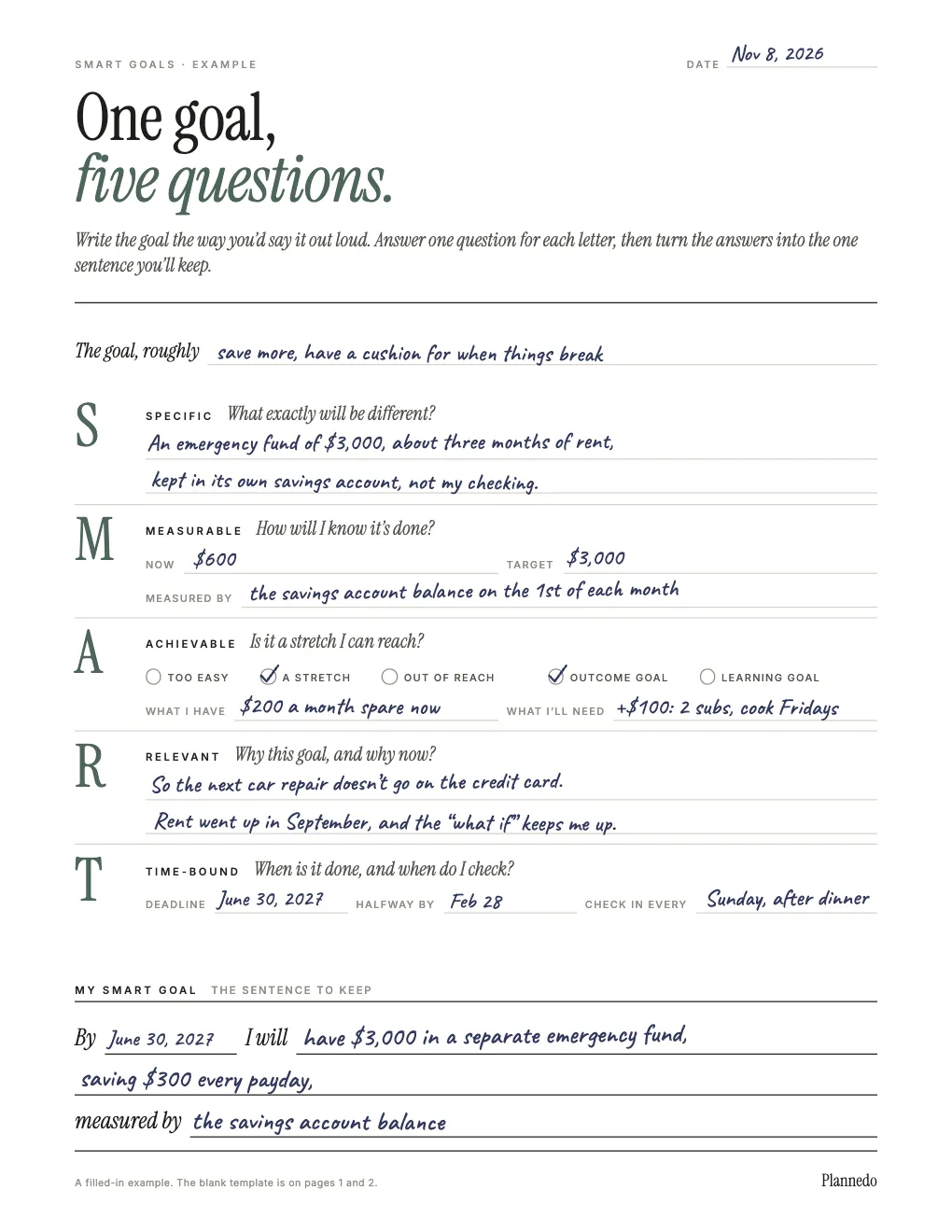
Here’s the template filled in with one goal from start to finish: someone who keeps saying “I should save more.”
1. Write the goal the way you’d say it
“Save more, have a cushion for when things break.” Don’t polish it. The rough version is the wish, and the five letters are there to sharpen it.
2. S: say exactly what will be different
“An emergency fund of $3,000, about three months of rent, kept in its own savings account.” Specific means a result you could point at, not an area of life. If the sentence would still be true if you did almost nothing (“be better with money”), it isn’t specific yet.
3. M: write where you are now and where you’re going
Now $600, target $3,000, measured by the balance on the 1st of each month. Writing the starting point matters: without it there’s no way to see progress, and seeing progress is what keeps a goal alive (more on that below).
If the result can’t be counted, make it something you could show: a finished draft, a booked trip, a signed lease. Doran didn’t insist on numbers either. And if a single number feels like a pass-or-fail exam, a range can help: in studies by Maura Scott and Stephen Nowlis, people with range goals (“lose 2 to 4 pounds”) felt their goals were both more attainable and more challenging, and in a weight-loss program they were more likely to sign up for another round than people given a single number.
4. A: aim for a stretch, not a sure thing
The template asks you to tick one: too easy, a stretch or out of reach. Aim for the middle. Here: $300 a month when $200 is spare now, so the plan needs another $100 from cancelling two subscriptions and cooking on Fridays. That’s a stretch with a path. Then tick whether it’s an outcome goal (you know how to get there) or a learning goal (you don’t yet). The section on the letter most people get wrong explains both.
5. R: write down why it matters now
“So the next car repair doesn’t go on the credit card.” A reason in your own words is what you’ll reread in March, when the goal is boring. If the honest answer is “because I’m supposed to,” choose a different goal.
6. T: set the deadline, a halfway mark and a check-in day
Deadline June 30, 2027; halfway by February 28, when the balance should be $1,800; check in every Sunday after dinner. A deadline alone is too far away to act on. The halfway mark tells you in February whether the plan works, and the check-in day is when you’ll look.
7. Write the sentence you’ll keep
“By June 30, 2027, I will have $3,000 in a separate emergency fund, saving $300 every payday, measured by the savings account balance.” Put it somewhere you’ll see it every week, not in a drawer.
8. Turn it into this week
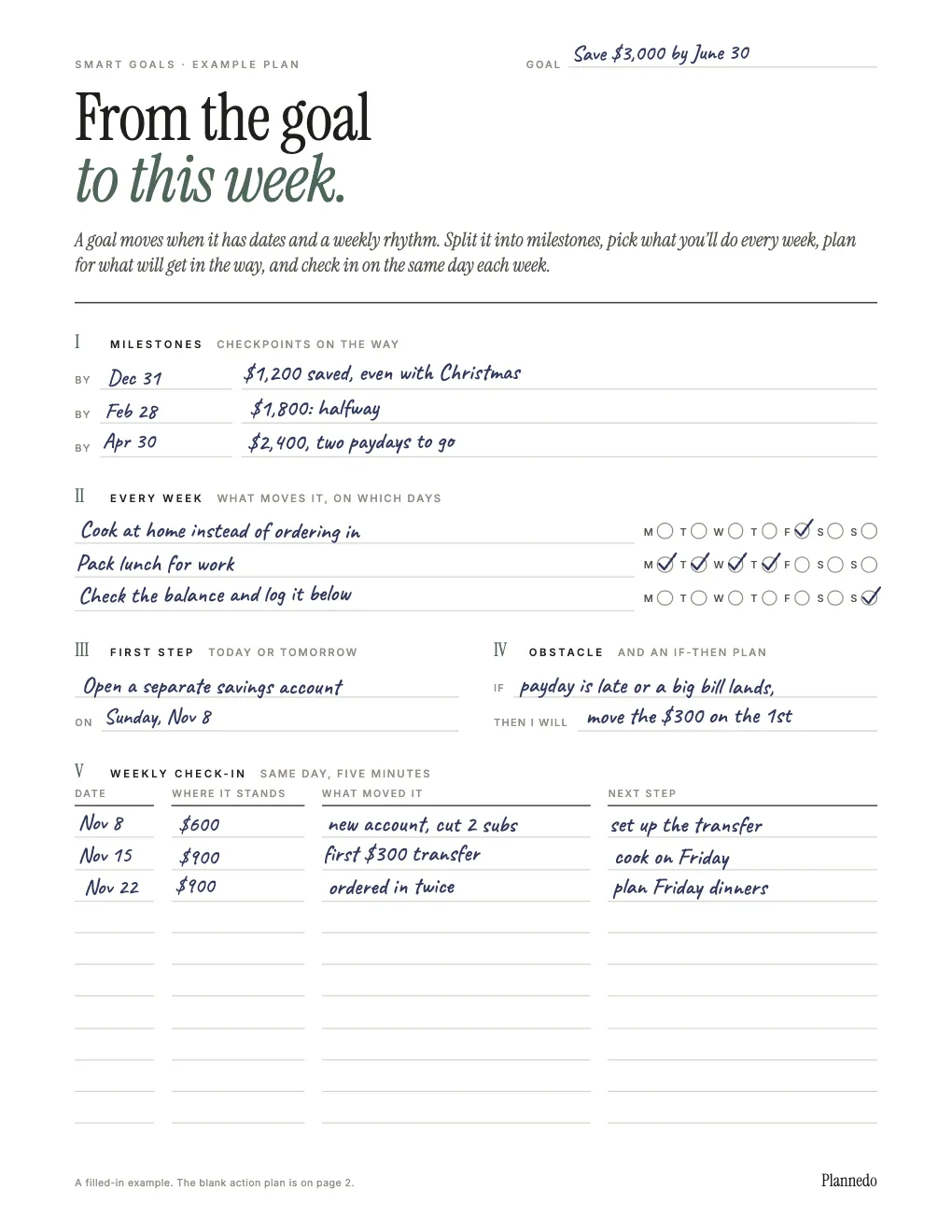
A SMART goal still doesn’t say what to do on Tuesday. The back page of the template does:
- Milestones with dates: $1,200 by December 31, $1,800 by February 28, $2,400 by April 30.
- Weekly actions with days: cook at home on Fridays, pack lunch Monday to Thursday, check the balance on Sunday.
- A first step for today or tomorrow: open a separate savings account.
- An if-then plan for the likeliest obstacle: if payday is late or a big bill lands, then I move the $300 on the 1st.
- A weekly check-in: the date, where it stands, what moved it and the next step.
The letter most people get wrong: A
“Achievable” is easy to read as “safe,” and the research points the other way. Edwin Locke and Gary Latham, reviewing 35 years of goal-setting studies, found that performance rose steadily with goal difficulty and leveled off only at the limits of people’s ability or when they stopped being committed. Specific, difficult goals beat “do your best” and beat easy goals. A 2017 meta-analysis of 141 papers on goal setting for behavior change by Tracy Epton, Sinead Currie and Christopher Armitage found the same: goal setting helped, and it helped most when goals were difficult, set publicly, or set as a group.
So read A as a stretch you can still see a path to. Two more things the letter hides:
- Outcome or learning goal. If you’ve never done anything like it, a hard outcome goal can backfire. In a study by Dawn Winters and Gary Latham, an outcome goal worked best on a simple task, but on a complex one a learning goal beat both the outcome goal and “try your hardest.” Gerard Seijts and Latham found that on a moderately complex task, “do your best” even beat a hard outcome goal, while a hard learning goal beat both. “Start a business by June” is an outcome with no known path; “talk to 20 potential customers by March 31” is a learning goal you can start on Monday.
- The result vs the actions. You can’t fully control a result like “get promoted” or “lose 10 pounds.” Keep the result as the goal, and make the weekly actions the part you control: the lessons, the meals, the calls. That’s what the back page is for.
Do SMART goals work?
The parts do. The acronym as a whole has never been tested against other ways of setting goals. A 2023 review by Christian Swann and colleagues, written about physical activity promotion, argues that SMART isn’t grounded in theory, is applied inconsistently, and doesn’t consider what type of goal is being set. Doran would probably agree with the last point: he wrote that the acronym doesn’t mean every objective needs all five criteria.
What has solid evidence is what SMART borrows and what it leaves out:
| Finding | What it means for your template |
|---|---|
| Specific, difficult goals beat “do your best” (Locke & Latham) | Specific and a stretch, not specific and safe |
| Learning goals beat outcome goals on new, complex tasks (Winters & Latham; Seijts & Latham) | Tick “learning goal” when you don’t know the way yet |
| Monitoring progress helps people reach goals, more so when progress is recorded and reported (Harkin et al., 138 studies) | A weekly check-in you write down, and someone to tell |
| If-then plans have a medium-to-large effect on reaching goals (Gollwitzer & Sheeran, 94 tests) | One if-then plan for the likeliest obstacle |
That’s why the template doesn’t stop at the five letters.
Two goal statistics to stop quoting
- “3% of Yale (or Harvard) graduates with written goals earned more than the other 97%.” The study never happened. Yale’s library checked its records and its administrators: no such survey of the Class of 1953 was done.
- “You’re 42% more likely to reach your goals if you write them down.” This comes from a small study by Gail Matthews at Dominican University of California, presented at a conference in 2015 and not published in a journal. Its results were people’s own ratings of how far they got after four weeks, and the “42%” seems to come from comparing average ratings, not the chance of reaching a goal. Its most interesting finding is the one people skip: the group that sent weekly progress reports to a friend rated themselves highest. That matches the much larger evidence on monitoring progress.
30 SMART goal examples
Each one is a vague goal rewritten as a SMART goal. Change the numbers and dates to fit your life: the point is the shape.
Personal
| Instead of | Try |
|---|---|
| Read more | By June 30, I will read 12 books, 30 minutes a night before bed. |
| Spend less time on my phone | By February 28, I will keep weekday screen time under 2 hours, checked every Sunday. |
| See friends more | By March 31, I will host dinner for friends on the first Saturday of each month. |
| Declutter the house | By April 30, I will clear one room a month and drop what I don’t keep at a donation center that weekend. |
| Learn to cook | By May 31, I will cook 10 new dinners from one cookbook, one every other week. |
Health and fitness
| Instead of | Try |
|---|---|
| Get fit | By March 28, I will run 5 km without stopping, training Tuesday, Thursday and Saturday. |
| Lose weight | By June 30, I will lose 8 to 12 pounds, weighed every Monday morning. |
| Sleep better | By January 31, I will be in bed by 11 p.m. at least five nights a week. |
| Get stronger | By May 31, I will do 10 push-ups in a row, practicing three times a week. |
| Walk more | By February 28, I will average 8,000 steps a day over a week, walking at lunch on workdays. |
Money
| Instead of | Try |
|---|---|
| Pay off debt | By December 31, 2027, I will pay off the $4,800 on my credit card, $400 on the 1st of every month. |
| Spend less on food | By March 31, I will cut takeout from $300 to $120 a month by cooking four nights a week. |
| Start investing | By April 15, I will open a retirement account and set up an automatic $150 a month. |
| Make a budget | By January 31, I will track every expense for a month and set February’s budget from it. |
Work
| Instead of | Try |
|---|---|
| Improve customer service | By March 31, I will cut first reply time on support tickets from 9 hours to 4, measured in the weekly report. |
| Be more productive | By February 28, I will keep two 90-minute focus blocks a week, notifications off, for eight weeks in a row. |
| Grow sales | By June 30, I will sign 6 new clients, booking 10 discovery calls a month. |
| Run better meetings | By March 31, I will cut our weekly team meeting from 60 minutes to 30, with an agenda sent the day before. |
| Hit deadlines | By the end of Q2, I will deliver 9 of 10 projects by the agreed date, with a 15-minute risk check every Monday. |
For a hundred more, with guardrails and wording for a performance review, see work goals examples.
Career growth
| Instead of | Try |
|---|---|
| Get promoted | By the December review, I will lead two cross-team projects end to end and ask my manager for feedback after each. |
| Learn a new skill | By April 30, I will finish an introductory SQL course and build three reports from our own data. (A learning goal.) |
| Network more | By June 30, I will have 12 coffee chats with people in roles I’d like, two a month. |
| Speak up more | By March 31, I will present one project update at the monthly all-hands, practiced out loud twice. |
Students
| Instead of | Try |
|---|---|
| Get better grades | By the end of the spring semester, I will raise my GPA from 3.1 to 3.4, studying 10 hours a week in the library. |
| Study more | By the March 12 midterm, I will review each lecture within 24 hours and take one practice exam a week. |
| Finish my thesis | By May 1, I will have a full draft, writing 500 words a day on weekdays. |
| Get an internship | By March 31, I will apply to 15 summer internships, three a week, each with its own cover letter. |
Nurses
| Instead of | Try |
|---|---|
| Improve patient education | By March 31, I will use teach-back with every patient I discharge and note it in the chart. |
| Get certified | By September 30, I will pass my specialty certification exam, studying five hours a week from January. |
| Prevent falls | By June 30, I will complete a fall-risk check within an hour of every admission and audit 10 of my charts a month. |
For goals across all of life, see personal goals examples; for the longer view, life goals examples.
How to track a SMART goal
A goal you don’t look at fades by February. Benjamin Harkin, Thomas Webb and colleagues combined 138 experiments with 19,951 participants and found that getting people to monitor their progress made them more likely to reach their goals. The effect was larger when progress was physically recorded and when it was reported to someone else.
- Every week, five minutes on the same day: where it stands, what moved it, the next step. That’s the check-in strip on the template.
- At the halfway mark: is the plan working? If not, change the plan before you change the goal.
- Every month or quarter: keep the goal, adjust it, or drop it on purpose. Our weekly review template covers the weekly part in 20 minutes.
The whole process, from choosing a goal to reviewing it, is in how to set goals and achieve them. If the obstacle is in your head rather than in your calendar, the WOOP method pairs well with a SMART goal.
SMART goals in Plannedo
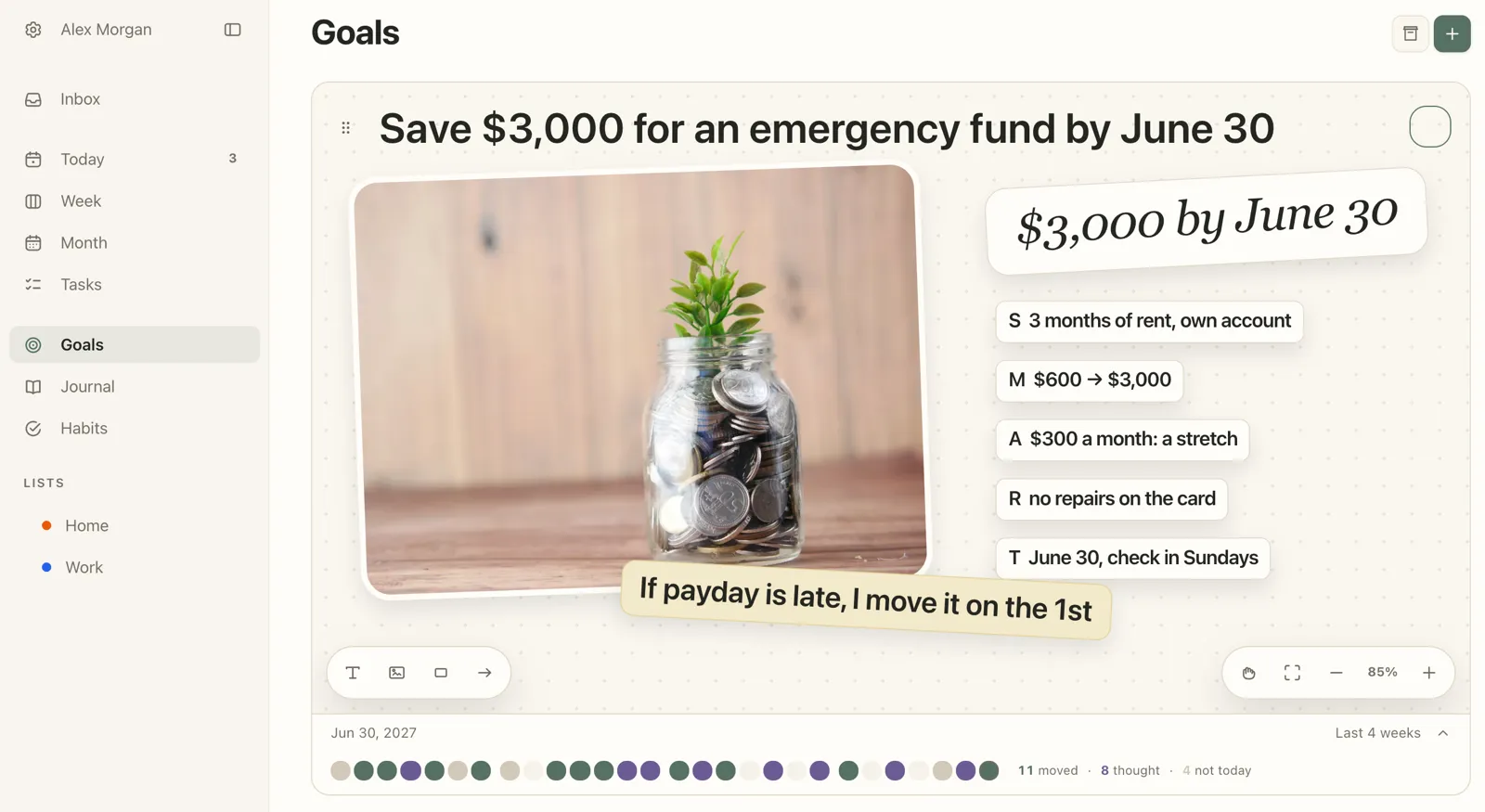
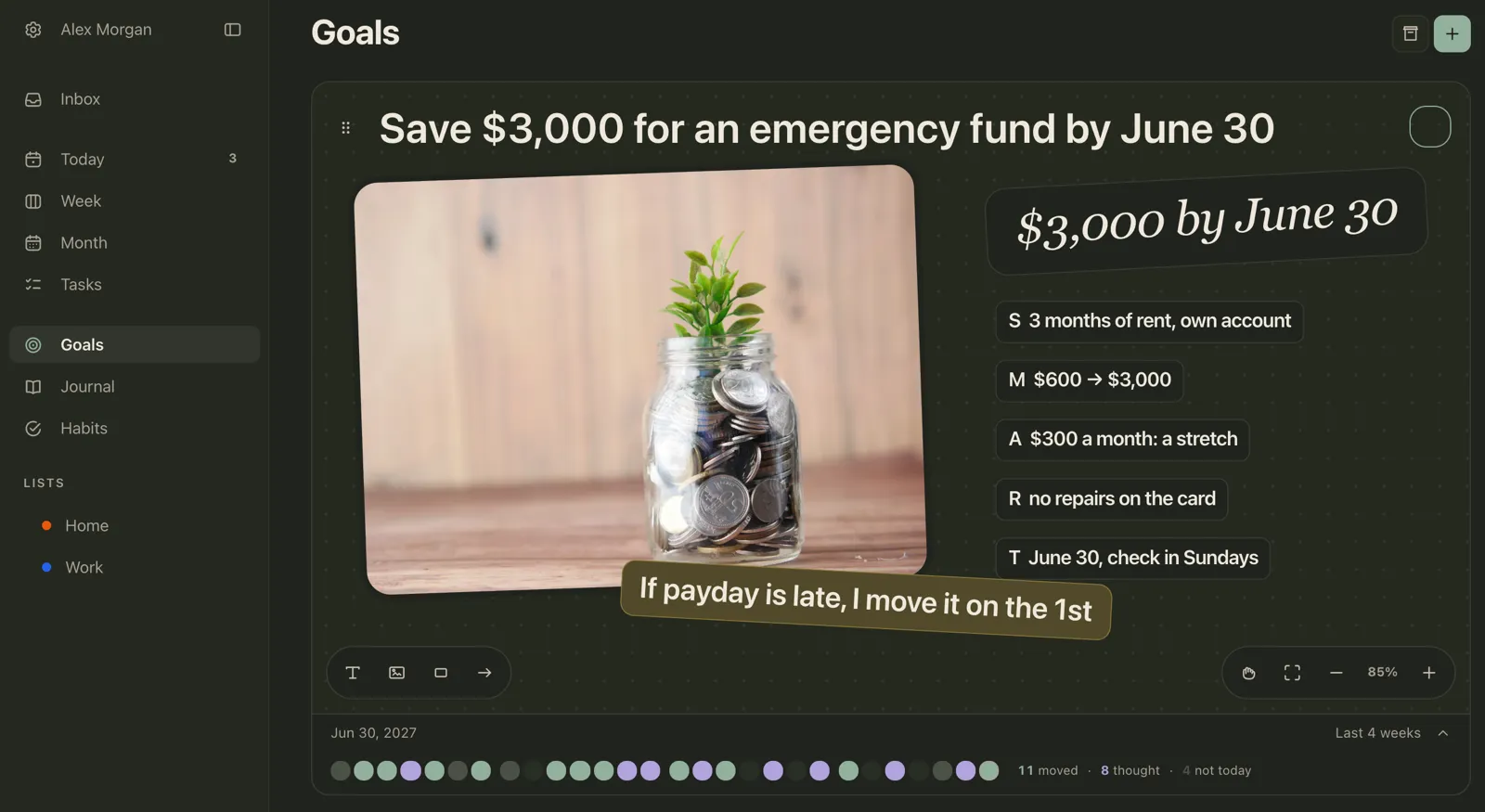
Plannedo keeps each goal on a board next to your day, so the template maps onto it directly. The SMART sentence goes in the goal’s title, the reason from R goes in the Note (it asks Why it matters), and the Deadline can be a date, a month, a quarter or a year. On the board, put the five answers as short text cards next to a photo of what done looks like.
The back page of the template maps onto the day:
- Weekly actions and the first step are tasks and habits with the goal in their Goal field, so they show up on Today with the goal’s name under them. A monthly transfer can repeat every month.
- The check-in is Log the day on Today: each evening it asks about each goal, Moved, Thought or Not today, and finishing a task linked to the goal marks it Moved for you.
- Tracking is the line under the board: open Last 4 weeks and the evening answers show as a row of dots with a count, the record the monitoring research asks for.
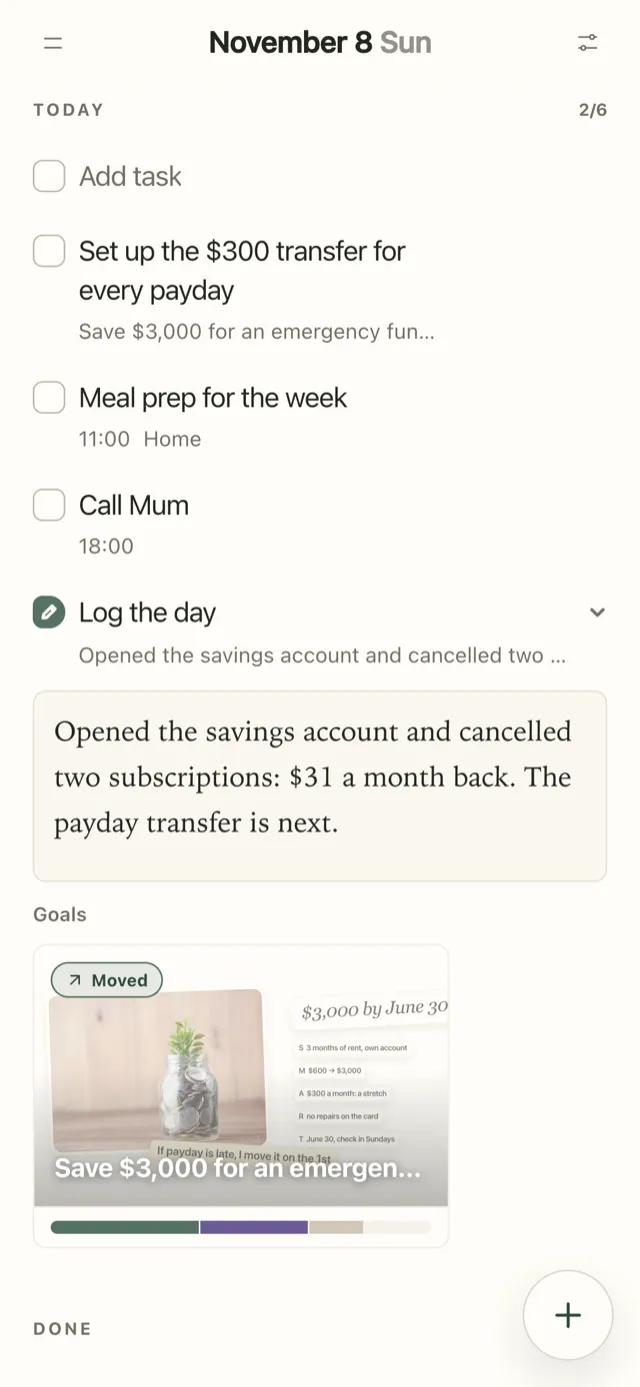
More in the help centre: goal boards, connecting tasks and habits to a goal and seeing which goals are moving.
Free SMART goals template (PDF)
Four pages: the template, the action plan, and both of them filled in with the emergency fund example above. Print pages 1 and 2 once per goal, or type straight into the fillable PDF on an iPad or a computer.
FAQ
What does SMART stand for in goals?
Specific, Measurable, Achievable, Relevant and Time-bound. In George Doran’s 1981 original, A was Assignable (who will do it), R was Realistic and T was Time-related. Today you’ll also see Attainable for A and Realistic for R.
What is an example of a SMART goal?
“By June 30, 2027, I will have $3,000 in a separate emergency fund, saving $300 every payday, measured by the savings account balance.” It names the result, the number and the deadline, and the target is a stretch with a plan behind it: $300 a month when $200 is spare now.
How do you write a SMART goal?
Start with the goal as you’d say it, answer one question for each letter, then write one sentence: “By [date], I will [specific result], measured by [evidence].” Add the main action if it isn’t obvious, and make sure the target is a stretch, not a sure thing.
Do all goals need to be SMART?
No. Doran himself wrote that not every objective has to be quantified or meet all five criteria. When you’ve never done anything like the goal, a learning goal (try three approaches, talk to 20 customers) works better than a hard number, and some results are better shown than counted.
Who created SMART goals?
George T. Doran, in a 1981 article in Management Review titled “There’s a S.M.A.R.T. way to write management’s goals and objectives.” It’s often credited to Peter Drucker, whose management by objectives came first, but the acronym first appears in Doran’s article.
What is the difference between SMART and SMARTER goals?
SMARTER adds two letters, and there’s no single version: you’ll see Evaluated and Reviewed, Exciting and Recorded, or Efficacy and Rewarding. Whatever the letters, the useful addition is a regular review of how the goal is going.
Do SMART goals actually work?
Their parts have good evidence: specific, difficult goals beat “do your best,” and tracking progress and if-then plans help people reach goals. The acronym as a whole has never been tested against other methods, and critics point out that it ignores the type of goal. Use it to check the wording, then plan the weeks.
How often should you review a SMART goal?
Check in once a week, on the same day, for five minutes: where it stands and the next step. Look harder at the halfway mark, and decide every month or quarter whether to keep, adjust or drop the goal.
Studies mentioned
- Doran, G. T. (1981). There’s a S.M.A.R.T. way to write management’s goals and objectives. Management Review, 70(11), 35-36.
- Rubin, R. S. (2002). Will the real SMART goals please stand up? The Industrial-Organizational Psychologist, 39(4), 26-27.
- Swann, C., Jackman, P. C., Lawrence, A., Hawkins, R. M., Goddard, S. G., Williamson, O., Schweickle, M. J., Vella, S. A., Rosenbaum, S., & Ekkekakis, P. (2023). The (over)use of SMART goals for physical activity promotion: A narrative review and critique. Health Psychology Review, 17(2), 211-226.
- Locke, E. A., & Latham, G. P. (2002). Building a practically useful theory of goal setting and task motivation: A 35-year odyssey. American Psychologist, 57(9), 705-717.
- Epton, T., Currie, S., & Armitage, C. J. (2017). Unique effects of setting goals on behavior change: Systematic review and meta-analysis. Journal of Consulting and Clinical Psychology, 85(12), 1182-1198.
- Winters, D., & Latham, G. P. (1996). The effect of learning versus outcome goals on a simple versus a complex task. Group & Organization Management, 21(2), 236-250.
- Seijts, G. H., & Latham, G. P. (2001). The effect of distal learning, outcome, and proximal goals on a moderately complex task. Journal of Organizational Behavior, 22(3), 291-307.
- Scott, M. L., & Nowlis, S. M. (2013). The effect of goal specificity on consumer goal reengagement. Journal of Consumer Research, 40(3), 444-459.
- Harkin, B., Webb, T. L., Chang, B. P. I., Prestwich, A., Conner, M., Kellar, I., Benn, Y., & Sheeran, P. (2016). Does monitoring goal progress promote goal attainment? A meta-analysis of the experimental evidence. Psychological Bulletin, 142(2), 198-229.
- Gollwitzer, P. M., & Sheeran, P. (2006). Implementation intentions and goal achievement: A meta-analysis of effects and processes. Advances in Experimental Social Psychology, 38, 69-119.
- Matthews, G. (2015). Goals research summary. Dominican University of California; presented at the 9th Annual International Conference on Psychology, Athens.
- Yale University Library. Where can I find information on Yale’s 1953 goal study? Ask Yale Library.
Photo credits
The cover photo is by Alena Ganzhela on Unsplash. The photo on the goal board in the app screenshots is by Towfiqu barbhuiya on Unsplash.