How to Start Journaling: A Beginner's Guide
How to start journaling as a beginner: seven steps, what to write, how to start a journal entry, nine ways to journal with examples, and what research says.
To start journaling, pick a time you already have every day, write a few lines at that time, and try a different way to journal each day for two weeks. Then keep the way, the time and the length that felt easiest. You don’t need a special notebook, a prompt or a big reason.
Most new journals don’t make it past the second week, and usually for the same reason: they start too big. A page a day is a promise you can only keep on good days. Three lines you can write on your worst day. Below are seven steps, how to start a journal entry, nine ways to journal with examples, and what research says about it.
What is journaling?
Journaling is writing regularly, for yourself, about your days, thoughts and feelings. A diary records what happened; a journal also asks what it meant, how it felt and what to do next. Nobody else reads it, so there’s no right way to do it: one line counts, a list counts, and so does a page you’ll never read again.
Benefits of journaling: what research says
Journaling research started with a small study. In 1986 James Pennebaker and Sandra Beall had 46 students write for 15 minutes on four evenings in a row about an upsetting experience. Over the next six months, visits to the student health center stayed flat for those who wrote about both the facts and their feelings, and went up in the other groups. The groups were small, but hundreds of writing studies followed. The honest summary is that journaling helps a little, reliably, and more in some forms than others.
- Writing about what upsets you. A 2006 review by Joanne Frattaroli pooled 146 studies and found a small but real benefit. It was slightly bigger when people wrote for at least 15 minutes a session, for at least three sessions, and alone in a room. Daily or weekly made no difference.
- Mental health. A 2022 review of 20 randomized trials found that short, structured writing exercises lowered anxiety, depression and PTSD scores a little more than control conditions did, though the authors rate the evidence as inconsistent.
- Writing about good things. In a 2004 study, 90 college students who wrote about a deeply positive experience for 20 minutes on three days in a row felt better afterward and made fewer sick visits to the campus health center over the next three months than a comparison group.
- Gratitude. In a 10-week study, Robert Emmons and Michael McCullough had students list up to five things they were grateful for, once a week. Compared with students who listed hassles or neutral events, they rated their lives as a whole higher, felt more optimistic about the coming week and reported fewer physical symptoms. In a small six-week pilot that Sonja Lyubomirsky and colleagues described in 2005, students who counted their blessings once a week got a little happier, while those who did it three times a week did not.
- Progress at work. In a study of nearly 12,000 daily diary entries from 238 professionals, Teresa Amabile and Steven Kramer found that making progress on meaningful work, even small steps, was what most often marked people’s best days. Writing down what moved is a way to notice it.
None of this makes a journal therapy, and the effects are modest. But it’s a cheap habit with a real upside, and the research also says something about how to do it: write privately, be honest about feelings, and keep going for more than a session or two.
How to start journaling in 7 steps
1. Pick one reason
Not a grand one. People usually start a journal for one of four reasons, and each suggests a different way to write:
| If you want to… | Start with |
|---|---|
| Clear your head | Free writing: five minutes of whatever is in there |
| Remember your days | Three lines, or one line a day |
| Work through something | Ten minutes on what happened, how it felt and what you make of it |
| See progress | A short log of what moved today |
You can change it later. A reason just tells you what to write on day one.
2. Use whatever is with you at that time
A notebook by the bed, the notes app, a journaling app: the best one is the one within reach at the moment you’ve picked. There’s no good evidence that handwriting works better than typing: the 2006 review of 146 writing studies found that writing by hand, typing or talking made no difference. If you buy a notebook, buy a cheap one. An expensive one makes people afraid to write badly in it.
3. Tie it to something you already do
“I’ll journal more” doesn’t survive a busy week. “After I brush my teeth at night, I write three lines” does. Psychologists call this an implementation intention, a plan in the form “when X happens, I’ll do Y.” In a 2006 meta-analysis of 94 tests, Peter Gollwitzer and Paschal Sheeran found that people who made plans like this were more likely to reach their goals than people who only set the goal, with a medium-to-large effect. Good anchors happen every day at about the same time: the first coffee, closing the laptop, getting into bed.
4. Start with five minutes or three lines
Keep the bar low enough to clear on a bad day. Three lines is enough: what happened, what worked, what to repeat. Decide in advance what counts on the worst days, such as one line, and count it.
5. Write the first entry tonight
Don’t wait for a new notebook, a Monday or the first of the month. Write the date and one sentence about today. The section below has ways to start when nothing comes.
6. Try a different way each day for two weeks
You don’t know yet whether you’re a three-lines person, a gratitude-list person or a free-writing person. For two weeks, try a different way each day from the table below, and note which days felt easy.
7. Don’t start over after a missed day
Write the next day, as if nothing happened. In a study of how habits form, Phillippa Lally and colleagues at UCL found that missing a single day didn’t materially affect how the habit formed. What kills journals is starting over with a bigger plan after a gap. Once a week, read back what you wrote. In a 2014 study, Ting Zhang and colleagues at Harvard Business School found that people badly underestimate how interesting it will be to rediscover ordinary moments later, and reading back is what turns a pile of entries into something you want to keep.
How to start a journal entry
Put the date at the top, then use any of these first lines. You don’t need “Dear diary.”
- Today I…
- Right now I feel…
- What’s taking up space in my head is…
- The best part of today was…
- I keep thinking about…
- Something I want to remember from today is…
- Tomorrow will be a good day if…
On the first page of a new journal, write the date, why you’re starting and your plan in one line: “After I close the laptop, I write three lines.” It’s the page you’ll read again in a year.
If you’d rather answer a question, our journal prompts has 150 of them, grouped by what you want from the entry.
What to write in a journal: 9 ways to journal
| Way | What you write | Time | Good for |
|---|---|---|---|
| Three lines | What happened, what worked, what to repeat | 3 min | Remembering your days, getting better at them |
| One line a day | A single specific detail of the day | 1 min | Keeping the habit on busy days |
| Free writing | Whatever is in your head, without stopping or fixing | 5 to 10 min | Clearing your head |
| Morning pages | Julia Cameron’s version: three pages by hand, first thing in the morning | 20 to 30 min | Creative work, a noisy mind |
| Gratitude list | Three good things from today, small ones included | 2 min | Mood, noticing what goes right |
| Prompts | The answer to one question | 5 to 10 min | Days when nothing comes |
| Expressive writing | What upset you, how it felt and what you make of it | 15 to 20 min | Working through something hard |
| Bullet journal | Ryder Carroll’s method: short bullets for tasks, events and notes, plus monthly pages | 5 to 10 min | Planning and journaling in one notebook |
| Progress log | One thing that moved today, at work or at home | 2 min | Seeing progress on long projects |
For the one-line version, see one line a day journal.
Journal entry examples
Three lines, an ordinary Friday:
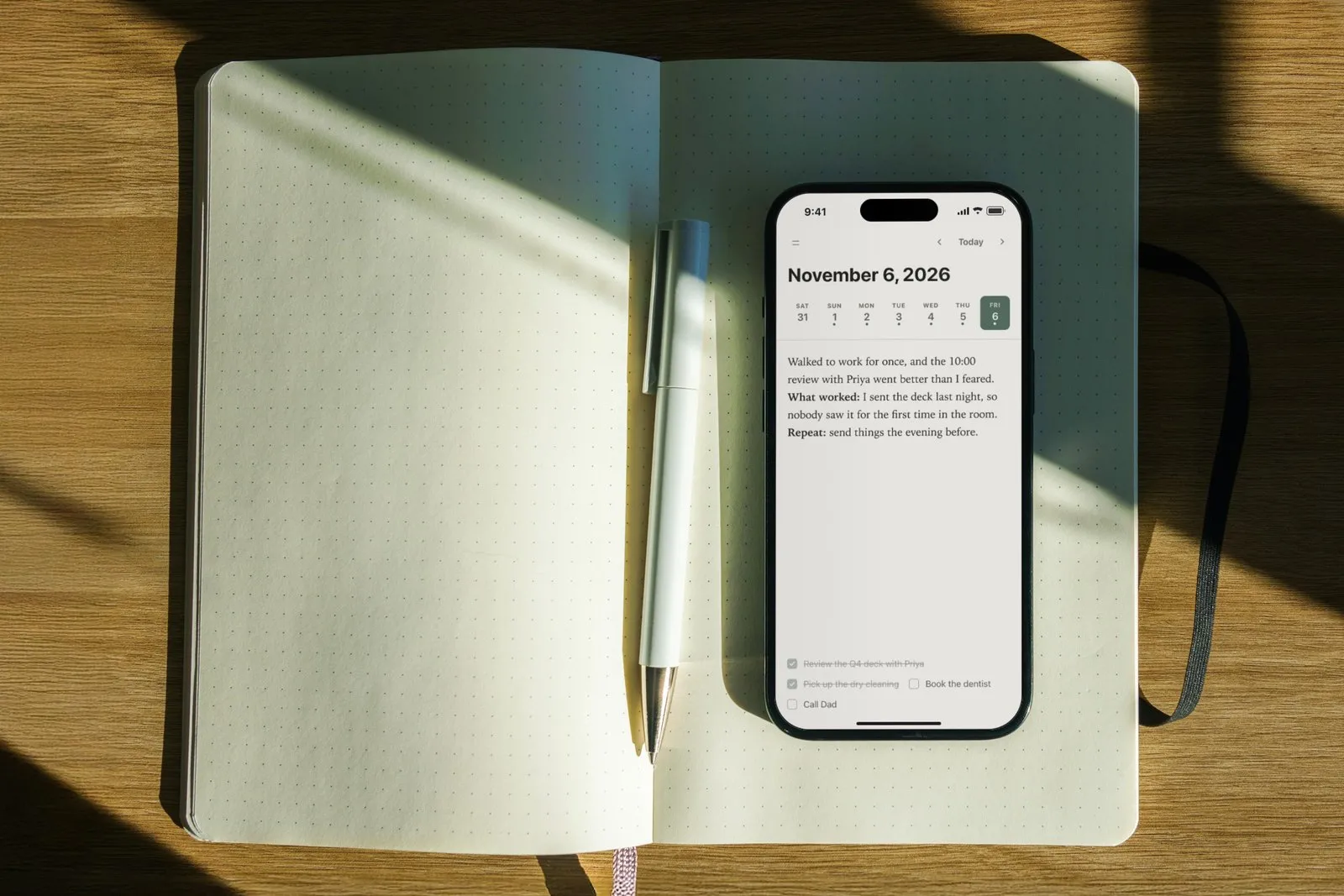
Walked to work for once, and the 10:00 review with Priya went better than I feared. What worked: I sent the deck last night, so nobody saw it for the first time in the room. Repeat: send things the evening before.
A gratitude list:
- Sam made coffee before I was up.
- The rain stopped exactly when I left the office.
- Mom laughed on the phone for the first time in weeks.
Ten minutes on something hard:
I snapped at Sam over the dishes, and it wasn’t about the dishes. The budget meeting went badly and I carried it home. I felt small in that meeting, and then I made someone else feel small. What I make of it: when work goes badly, I need ten minutes alone before I talk to anyone. Next: apologize tonight, and tell Sam about the meeting.
How to journal every day
- Same anchor, every day. Write after the same thing, so you don’t have to decide each time.
- Keep it where you’ll be. A notebook by the bed for evening journaling, the app on your phone if you write on the train.
- Have a bad-day version. One line. It keeps the chain going without a fight.
- Expect it to take weeks. In the same UCL study, it took a median of 66 days for a daily behavior to feel automatic, and anywhere from 18 to an estimated 254 days for different people. Keep the bar low until writing feels like something you just do.
- Let a missed day be a missed day. Don’t catch up on three days at once; write today.
How to journal for mental health and anxiety
Journaling isn’t a treatment, but two kinds of writing have the best evidence behind them.
Expressive writing, for something that weighs on you. Write for 15 to 20 minutes about what happened, how it felt and what you make of it, on three or four days. That’s the format most of the studies above used. Write it for yourself: in the 2022 review, studies where nobody collected or read the journals worked better.
Positive journaling, for anxiety. In a small 2018 trial, Joshua Smyth and colleagues had 70 adults with health conditions and raised anxiety write online for 15 minutes, three times a week, about things like what they were thankful for or what someone had done for them. Within a month they felt less anxious and stressed than a comparison group, though that edge faded over the next two months.
Two cautions. Writing about something painful can make you feel worse for a while: a review for psychiatrists by Karen Baikie and Kay Wilhelm calls a short-term rise in distress the usual first effect, with no sign that it does lasting harm. Stop whenever you want, and if the same thoughts go round and round, switch to the next step you can take. And if you’re struggling, a journal is a help alongside treatment, not instead of it.
For questions to write about, see journal prompts for anxiety and stress.
Journaling in Plannedo
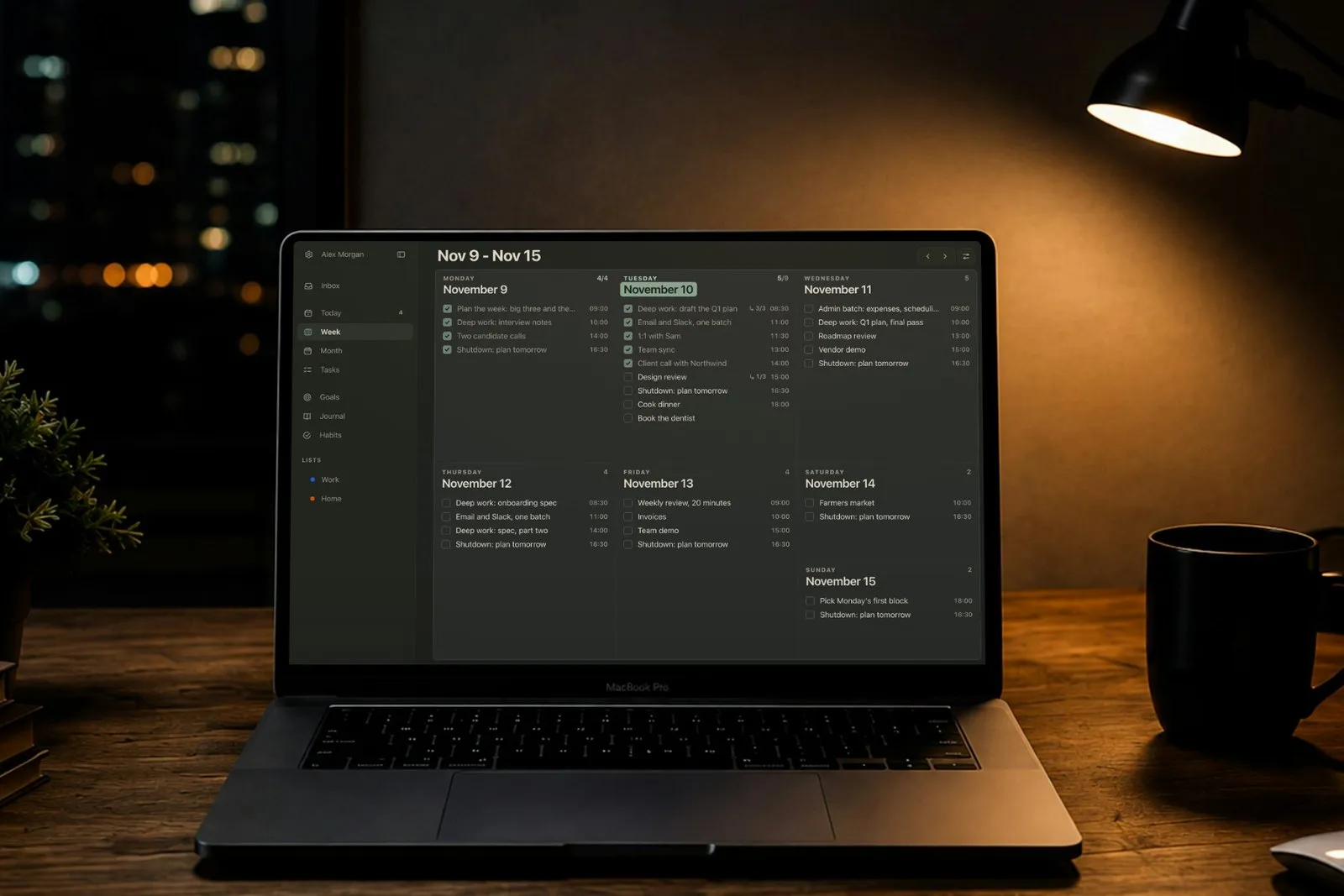
Plannedo is a planner with the journal built into the end of the day, which takes care of steps 3 and 4. On Today, under the day’s tasks, sits Log the day: open it in the evening, when you look at what’s done anyway, and write a few lines. An empty entry asks three questions of its own, What did you do today? What worked? What should be repeated?, so the page is never blank.
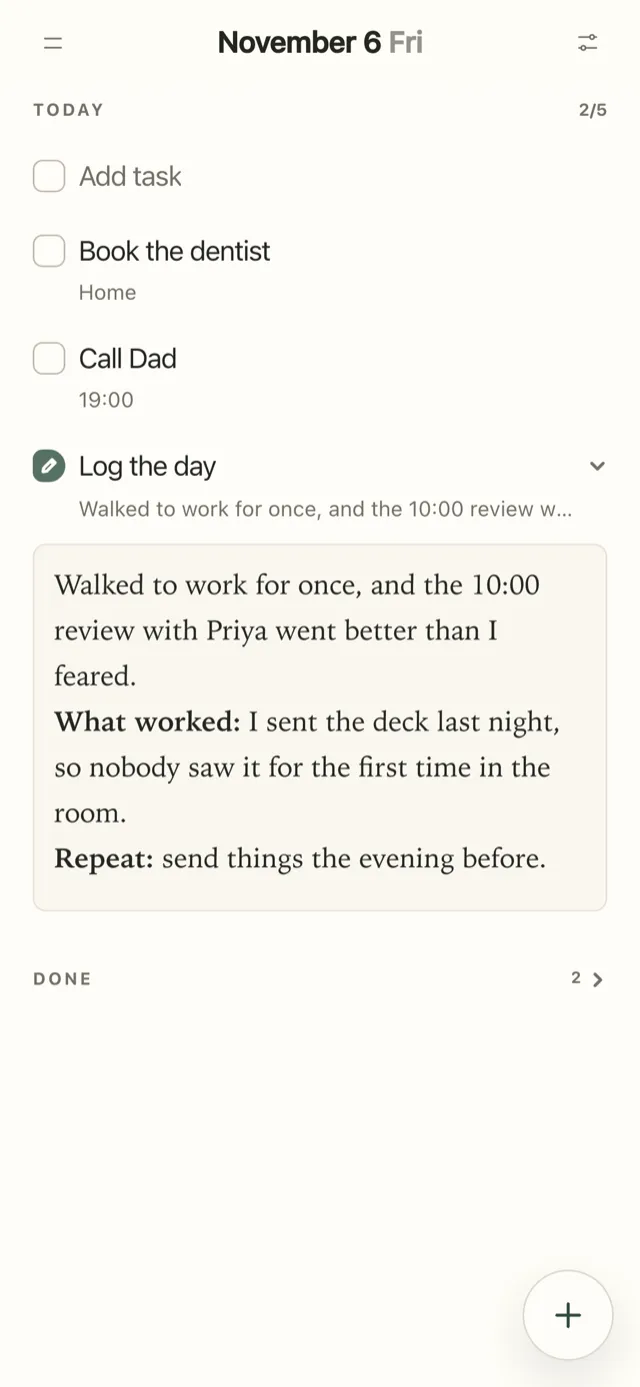
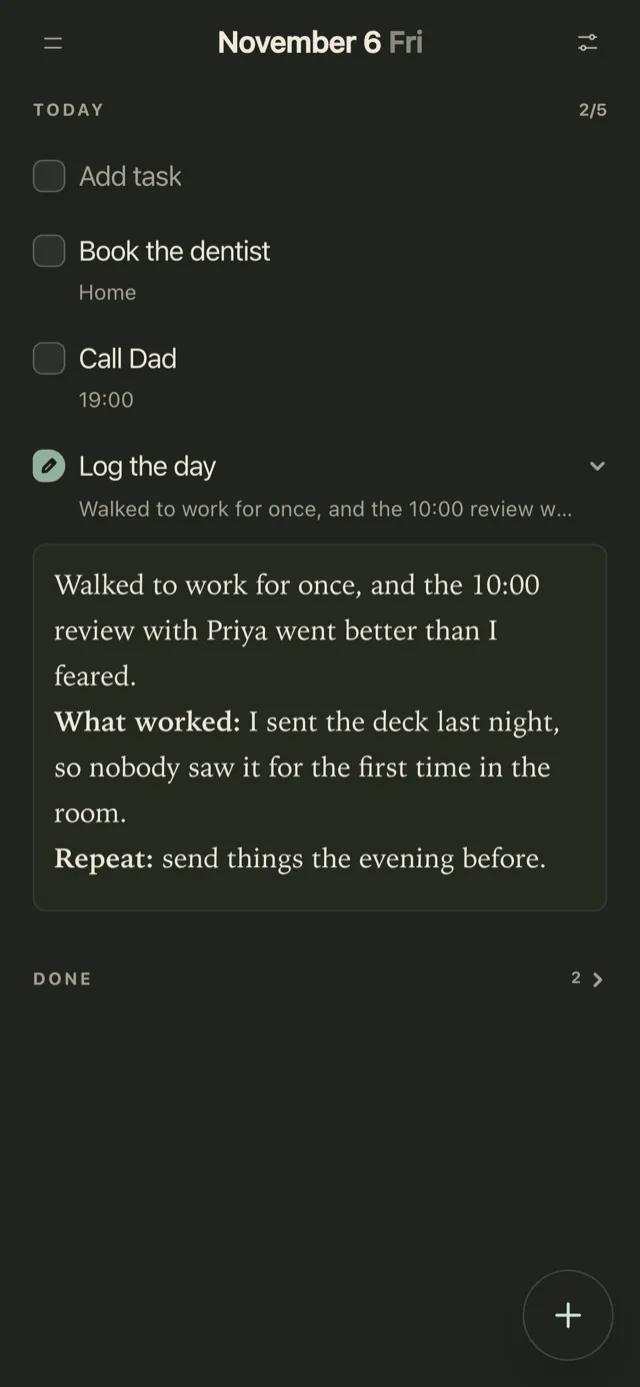
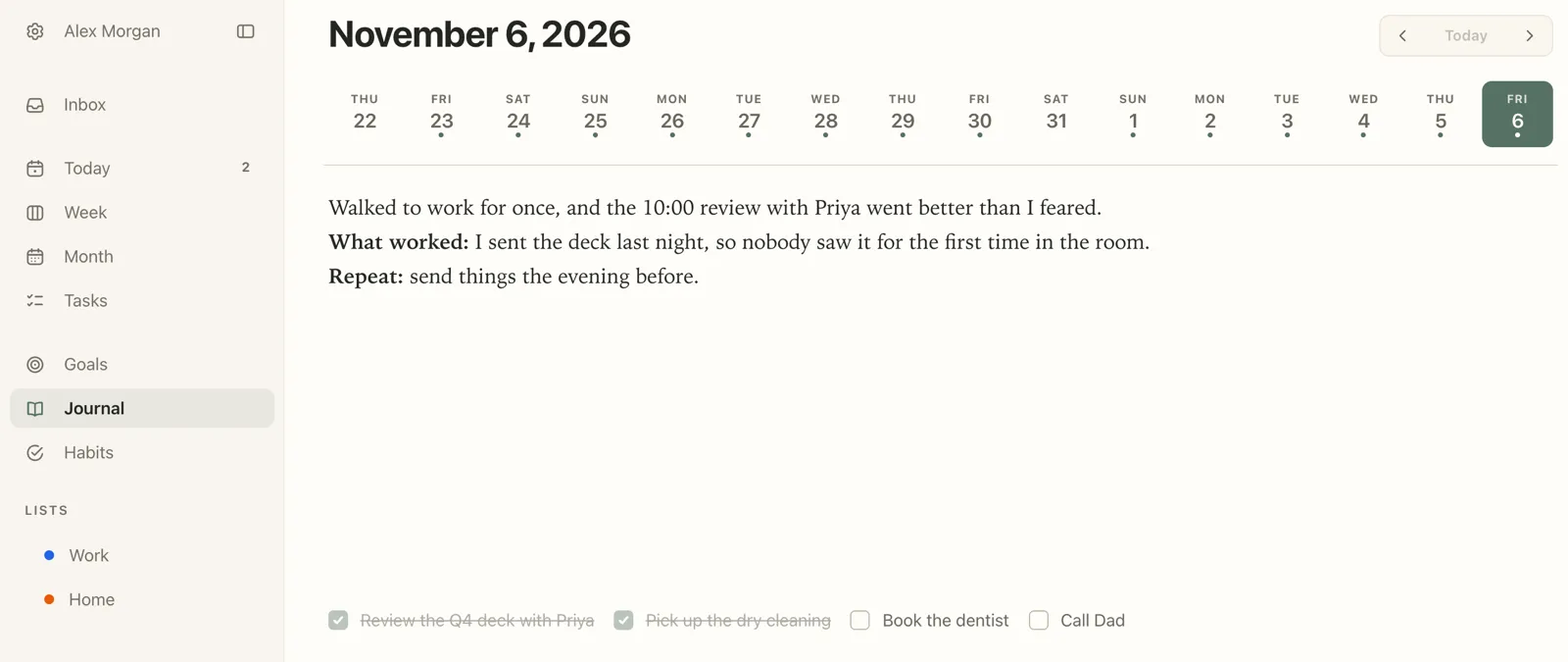
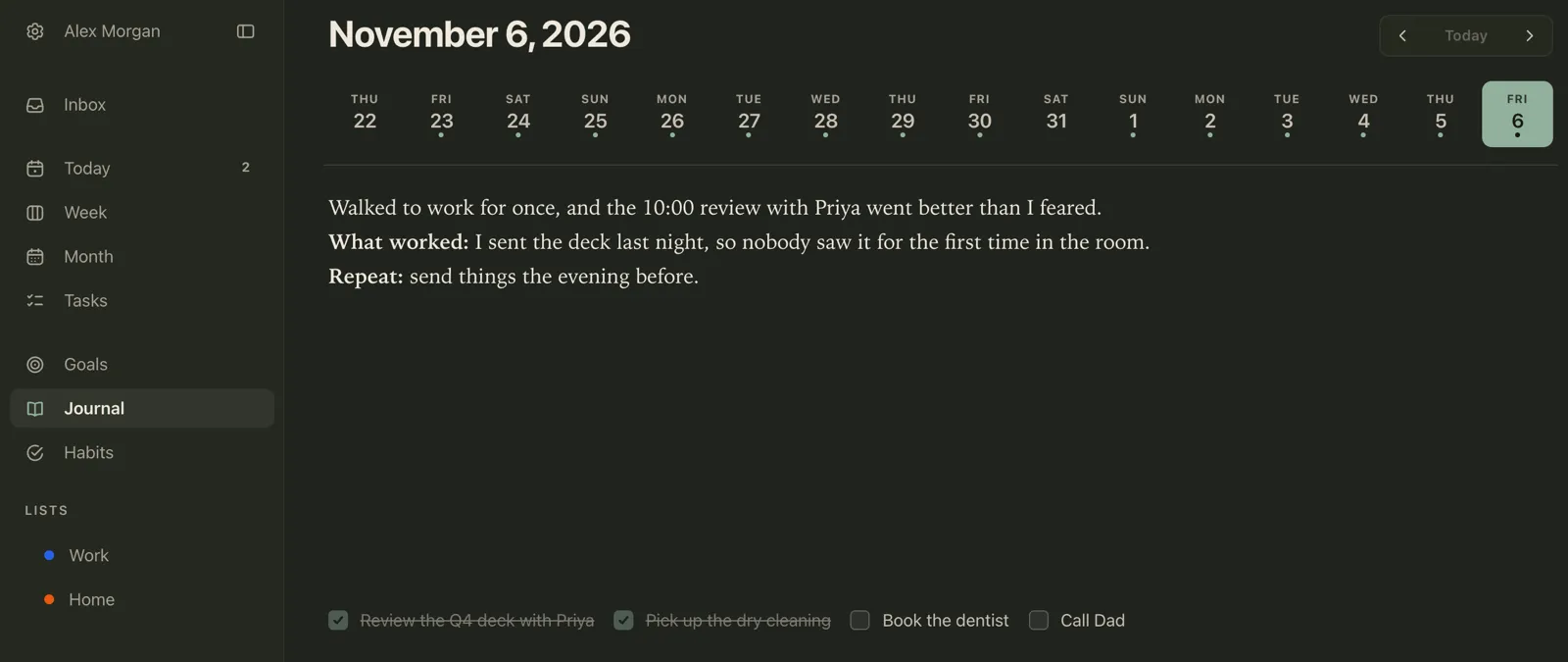
Each day has one entry, and it saves itself as you type. On the Journal page, a strip of days shows a dot under every day with an entry, and under the entry you see what that day held: its tasks, habits and goals. The journal isn’t scored, and nothing breaks when you miss a day: the dot is just missing.
More in the help centre: the journal and the evening check-in.
FAQ
How do I start journaling if I don’t know what to write?
Write three lines about today: what happened, what worked, what to repeat. If that’s too much, write one sentence that starts with “Today I…”. On days when nothing comes, answer a single prompt, such as “What’s taking up space in my head?”
How long should I journal each day?
Five minutes or three lines is enough to start. Most writing studies used sessions of 15 to 20 minutes, and a 2006 review of 146 of them found slightly bigger benefits at 15 minutes or more. For a daily habit, start short and let it grow on the days you have more to say.
Is it better to journal in the morning or at night?
No study has compared morning and evening journaling head to head, so pick a time you can protect every day. The evening suits looking back at the day; the morning suits clearing your head before it starts.
Should I journal on paper or in an app?
Use whatever is with you at the time you’ve picked. There’s no good evidence that handwriting works better than typing: a 2006 review of 146 writing studies found no difference. Paper feels slower and more private; an app is always in your pocket and easy to search.
What should I write on the first page of a journal?
The date, why you’re starting, and your plan in one line, such as “After I close the laptop, I write three lines.” Then write the first entry on the same page.
How do I start a journal entry?
Write the date, then a first line like “Today I…”, “Right now I feel…” or “I keep thinking about…”. You don’t need “Dear diary,” and the entry doesn’t need a title.
What if I miss a day of journaling?
Write the next day and don’t try to catch up. In a study of habit formation at UCL, missing a single day didn’t materially affect how the habit formed. Gaps only become a problem when you wait for a fresh start.
Is there an app for journaling?
Yes. Plannedo has a journal built into the end of the day: Log the day on Today asks what you did, what worked and what should be repeated, and the Journal page shows a dot for each day with an entry, next to that day’s tasks and habits. It runs on iPhone, Mac and the web, and the journal is included every day on the free plan.
Studies mentioned
- Amabile, T. M., & Kramer, S. J. (2011). The power of small wins. Harvard Business Review, 89(5).
- Baikie, K. A., & Wilhelm, K. (2005). Emotional and physical health benefits of expressive writing. Advances in Psychiatric Treatment, 11(5), 338-346.
- Burton, C. M., & King, L. A. (2004). The health benefits of writing about intensely positive experiences. Journal of Research in Personality, 38(2), 150-163.
- Emmons, R. A., & McCullough, M. E. (2003). Counting blessings versus burdens: An experimental investigation of gratitude and subjective well-being in daily life. Journal of Personality and Social Psychology, 84(2), 377-389.
- Frattaroli, J. (2006). Experimental disclosure and its moderators: A meta-analysis. Psychological Bulletin, 132(6), 823-865.
- Gollwitzer, P. M., & Sheeran, P. (2006). Implementation intentions and goal achievement: A meta-analysis of effects and processes. Advances in Experimental Social Psychology, 38, 69-119.
- Lally, P., van Jaarsveld, C. H. M., Potts, H. W. W., & Wardle, J. (2010). How are habits formed: Modelling habit formation in the real world. European Journal of Social Psychology, 40(6), 998-1009.
- Lyubomirsky, S., Sheldon, K. M., & Schkade, D. (2005). Pursuing happiness: The architecture of sustainable change. Review of General Psychology, 9(2), 111-131.
- Pennebaker, J. W., & Beall, S. K. (1986). Confronting a traumatic event: Toward an understanding of inhibition and disease. Journal of Abnormal Psychology, 95(3), 274-281.
- Smyth, J. M., Johnson, J. A., Auer, B. J., Lehman, E., Talamo, G., & Sciamanna, C. N. (2018). Online positive affect journaling in the improvement of mental distress and well-being in general medical patients with elevated anxiety symptoms: A preliminary randomized controlled trial. JMIR Mental Health, 5(4), e11290.
- Sohal, M., Singh, P., Dhillon, B. S., & Gill, H. S. (2022). Efficacy of journaling in the management of mental illness: A systematic review and meta-analysis. Family Medicine and Community Health, 10(1), e001154.
- Zhang, T., Kim, T., Brooks, A. W., Gino, F., & Norton, M. I. (2014). A “present” for the future: The unexpected value of rediscovery. Psychological Science, 25(10), 1851-1860.
Photo credits
The cover photo is by Jakub Żerdzicki on Unsplash.