How to Stick to New Year's Resolutions (Backed by Research)
Seven research-backed ways to keep a New Year's resolution past February, from how you word it to the 66 days a new habit needs.
To stick to a New Year’s resolution, make it something to start rather than something to stop, decide exactly when and where you’ll do it, and name the obstacle that usually stops you before it shows up. Then shrink it to a weekly action, give it about two months to become a habit, check in briefly every evening, and when you slip, restart on the next Monday instead of quitting.
Each of those comes from a study, and some of the numbers are surprising. Below is the evidence behind each step, a week-by-week plan for January, and how I’d set it up in Plannedo, the planner I build.
How many people keep their New Year’s resolutions?
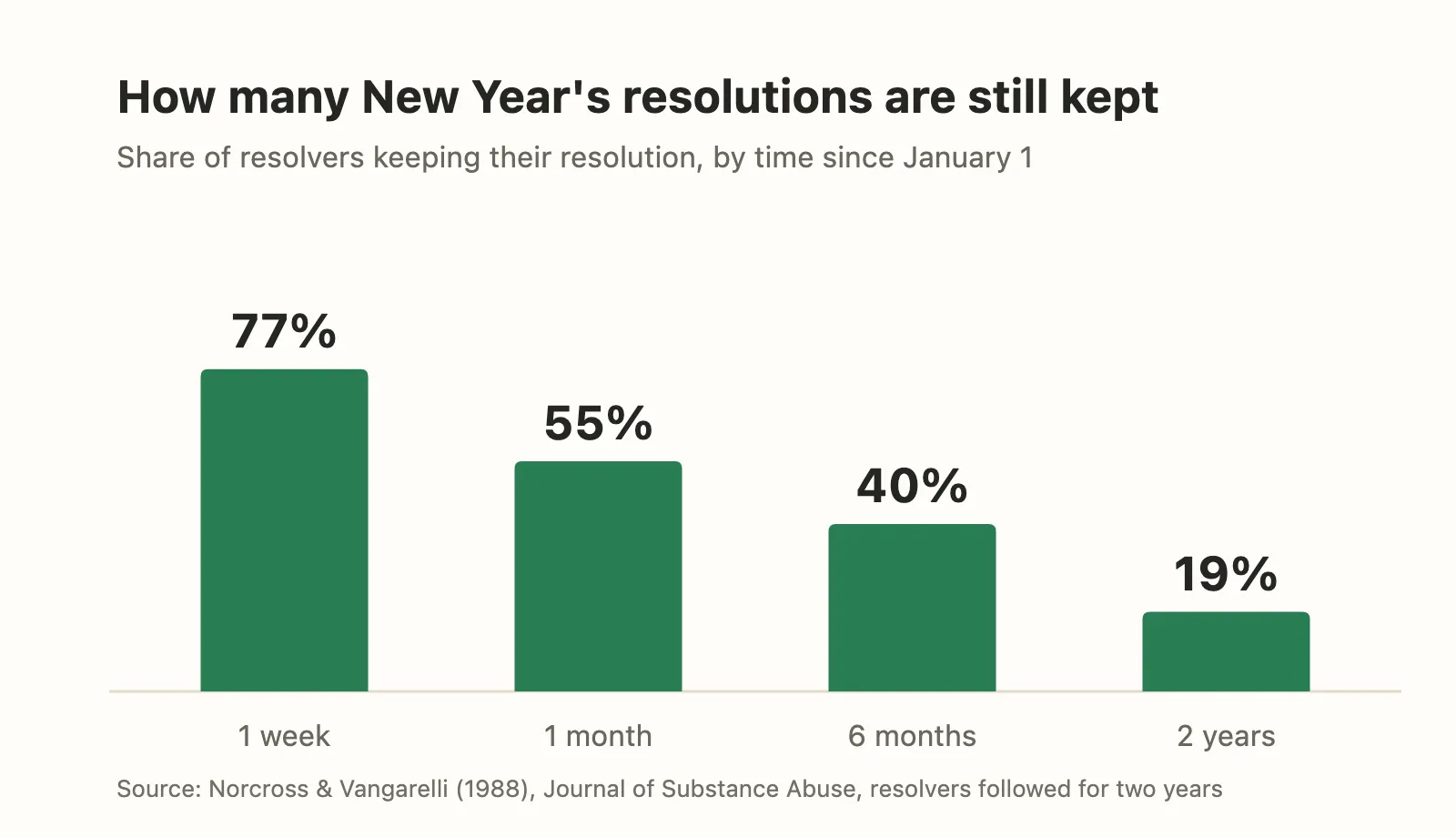
The classic numbers come from a two-year study by the psychologists John Norcross and D. J. Vangarelli, published in 1988. A week in, 77% were still keeping their resolution. After a month, 55%. After six months, 40%. After two years, 19%.
That sounds bleak until you look at the comparison. In a 2002 study, Norcross and colleagues followed 159 people who made resolutions and 123 people who wanted to change the same kinds of things but didn’t make a resolution. After six months, 46% of the resolvers were still succeeding, against 4% of the non-resolvers. Both studies rely on what people reported about themselves, so the exact figures are soft, but the gap is not small.
A larger experiment in Sweden, published in 2020, followed 1,066 people through 2017. At the end of the year, 55% of those who answered considered themselves successful. The most common resolutions were about physical health, weight and eating, as you’d expect.
Fitness apps see the drop in their data too. Strava publishes a “Quitter’s Day” most years, the point where activity uploads fall off after the January rush. It usually lands in the second or third week of January.
So the short version: making a resolution helps, and most of the damage happens in the first month. The question is what the people who make it past February do differently.
Why January works, and why it isn’t enough
New Year is a real advantage. In 2014, Hengchen Dai, Katherine Milkman and Jason Riis showed that people are more likely to start working on their goals right after what they called temporal landmarks: the start of a year, a month, a week, or a birthday. Google searches for “diet”, gym visits and sign-ups for goal commitments all rose after them. They named it the fresh start effect. A new calendar makes the old, less disciplined self feel like a different person.
The catch is that the feeling fades on its own schedule, roughly when the first hard week arrives. Motivation gets you to January 2. The rest of this post is about what carries you after that.
Seven things that make resolutions stick
1. Resolve to start something, not to stop something
The Swedish study had one clear finding about wording. People whose resolutions were about adopting something new (“approach” goals) were more successful than people whose resolutions were about quitting or avoiding something: 58.9% against 47.1%.
That’s an easy change to make before January 1. Rewrite every “stop” as a “start”:
| Instead of | Try |
|---|---|
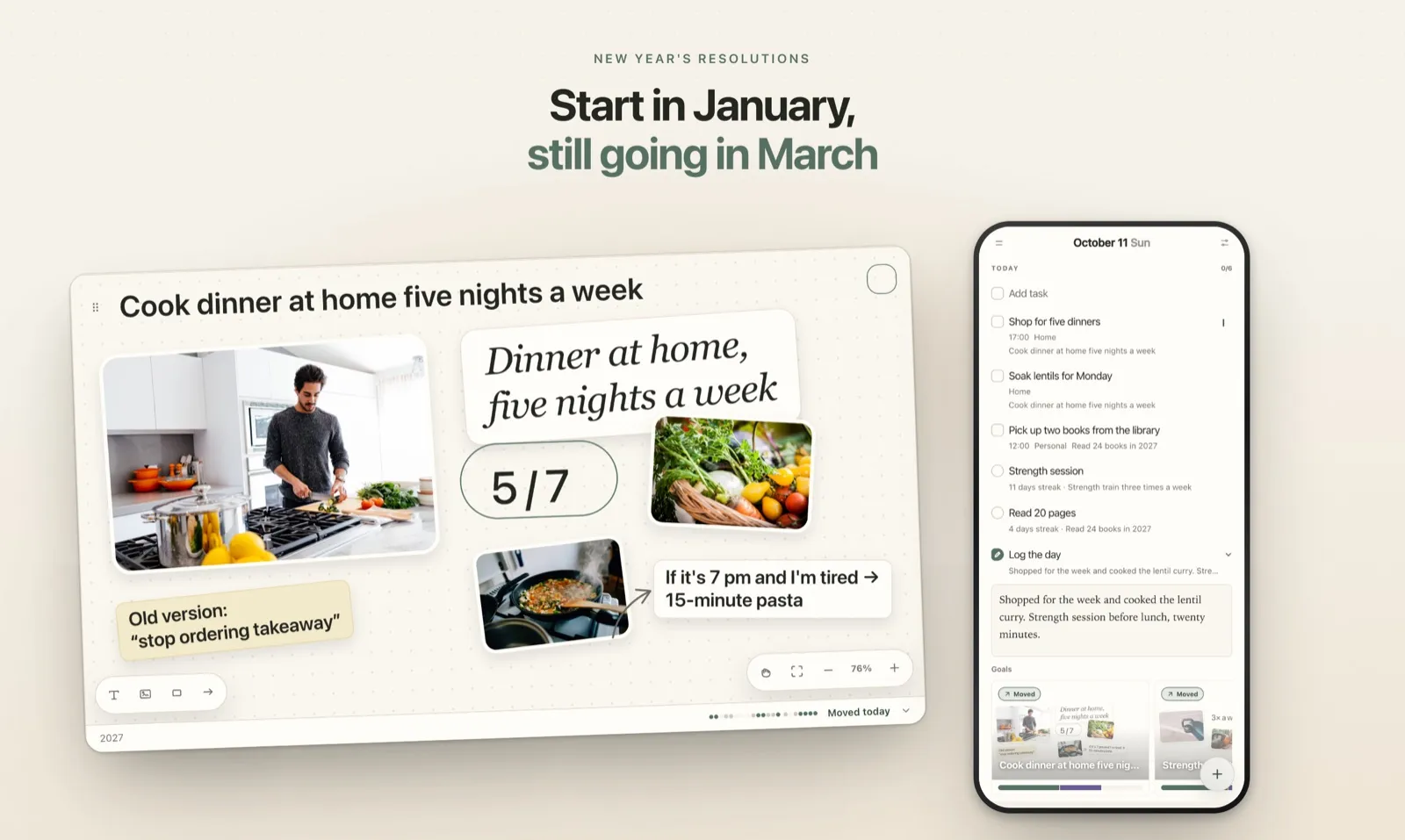
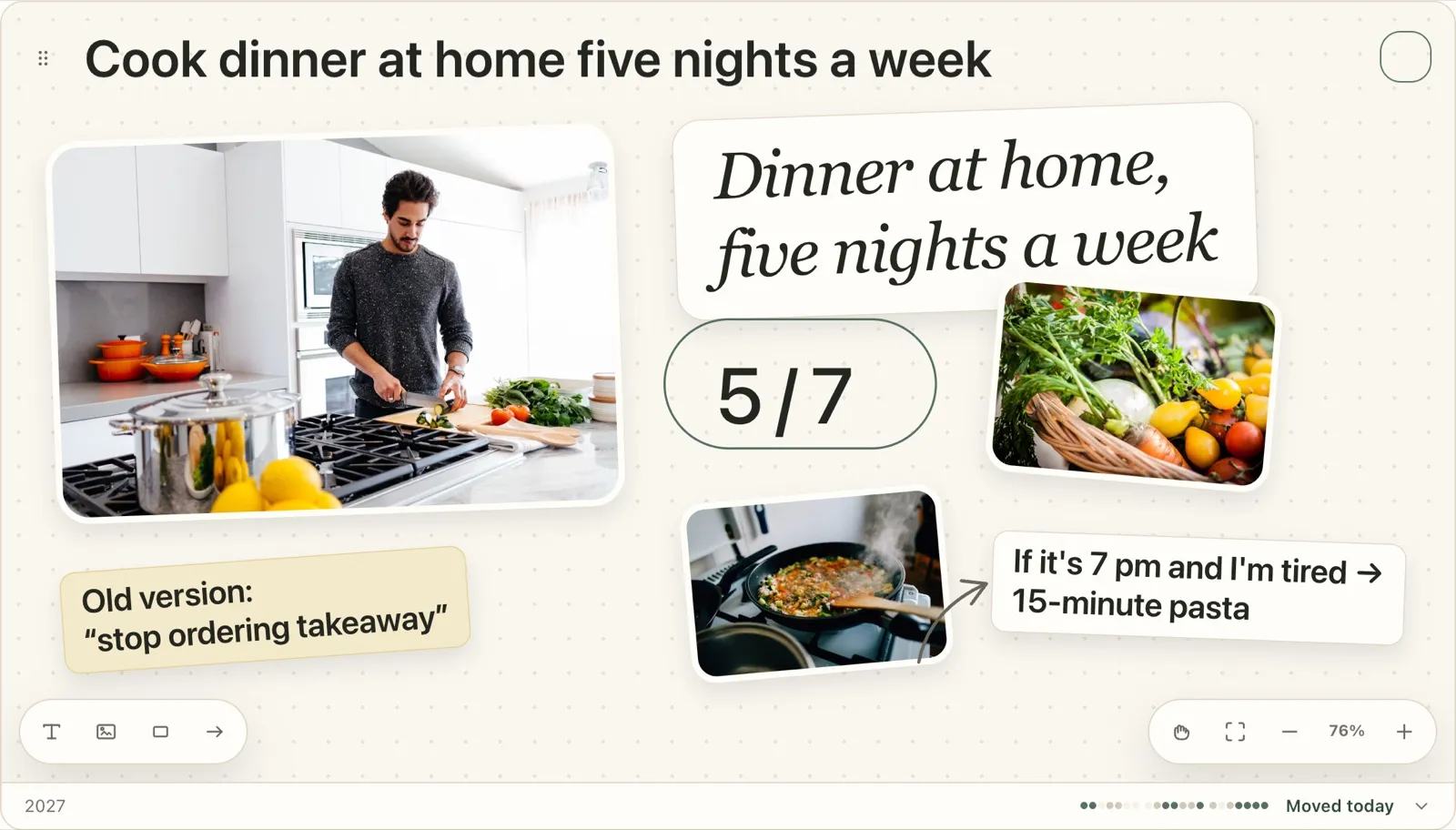
| Stop ordering takeaway | Cook dinner at home five nights a week |
| Stop scrolling in bed | Read 20 pages before sleep |
| Stop being so unfit | Strength train three times a week |
| Stop overspending | Move a fixed amount to savings on payday |
| Stop working late | Leave the office by 6 four days a week |
2. Decide when and where you’ll do it
A resolution says what you want. It rarely says when you’ll do it, and that gap is where most of them leak away. Peter Gollwitzer’s research on implementation intentions, plans in the form “if situation X, then I do Y”, is some of the most replicated work in this area. A 2006 meta-analysis of 94 tests found an average effect of d = 0.65 on reaching goals, which counts as medium to large.
For a resolution, that means turning “cook more” into “on weekdays, when I get home, I start dinner before I open my laptop”. If you can’t say when the next session happens, the resolution doesn’t have a plan yet.
3. Name the obstacle before it shows up
Gabriele Oettingen’s work on mental contrasting found that picturing the goal and then picturing the main thing in you that gets in the way works much better than picturing the goal alone. She turned it into a four-step exercise called WOOP: Wish, Outcome, Obstacle, Plan.
The obstacle is usually predictable. You know you’ll skip the gym when the day runs late, and you know takeaway wins when you’re tired at 7. Write that down in one sentence, then write the if-then plan for it: “If it’s 7 pm and I’m tired, 15-minute pasta.” I went through this research in more detail in Do Vision Boards Work?.
4. Make it a weekly action and give it about 66 days
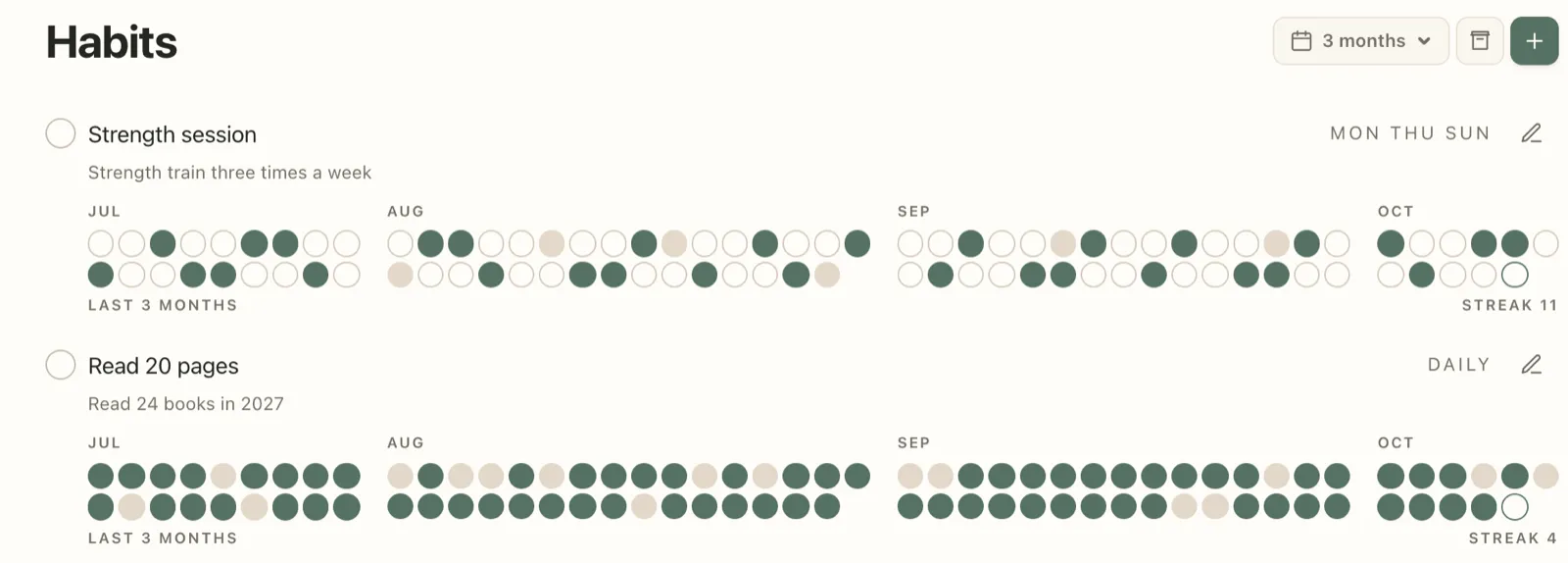
“Get fit” isn’t something you can do on a Tuesday. “Strength session on Monday, Thursday and Sunday” is. Every resolution needs a small action with a schedule.
Then give it time. In a 2010 study at University College London, Phillippa Lally and colleagues asked 96 volunteers to pick one eating, drinking or exercise habit, repeat it daily at the same point in the day, and report how automatic it felt. The median was 66 days, with a huge range: from 18 days to an estimated 254. That’s well past the end of January, which is exactly when most people give up.
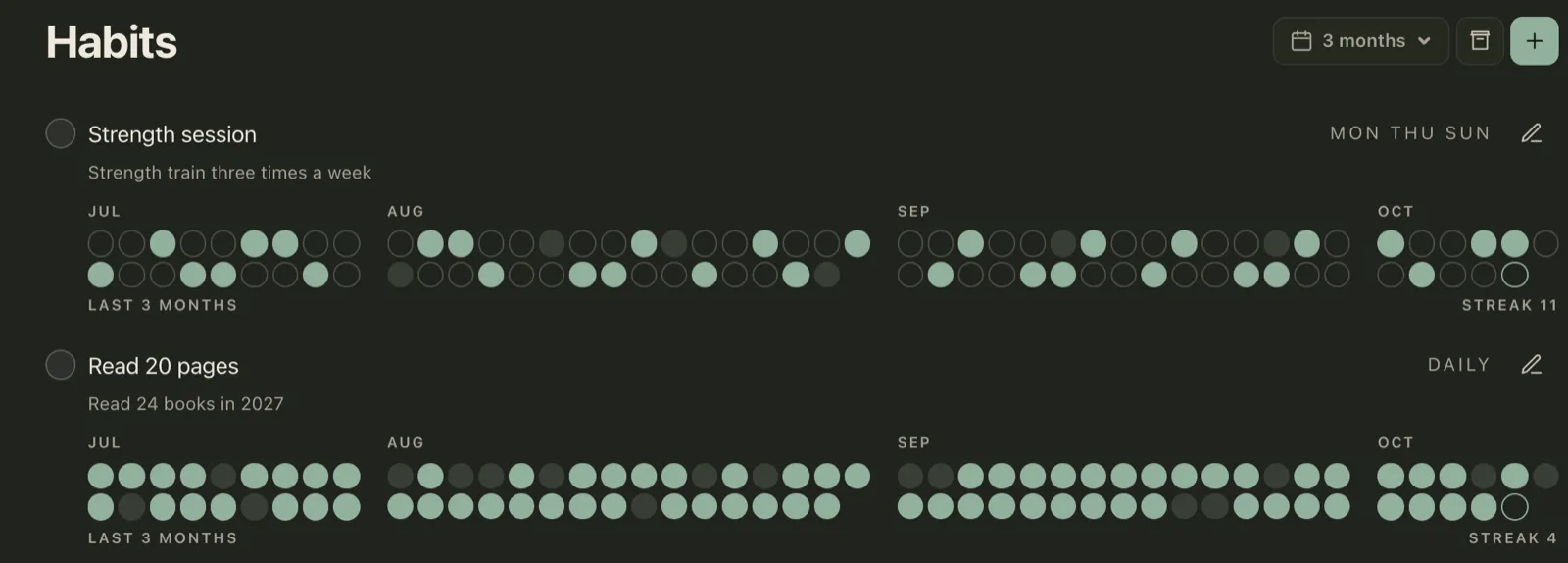
The same study had one more finding worth keeping: missing a single day didn’t materially affect how the habit formed. A skipped session is a gap, not a reset.
5. Pair it with something you enjoy
Katherine Milkman, Julia Minson and Kevin Volpp ran an experiment in which people could only listen to gripping audiobooks while at the gym. They called it temptation bundling. Early on, that group went to the gym 51% more often than the control group. The effect faded after a few weeks, around the holidays, so it isn’t magic, but it’s a cheap way to get through the hardest stretch.
Save a podcast for the walk, a show for the treadmill, the good coffee for the morning you write.
6. Check in every evening, review every week
Progress is motivating when you can see it. Teresa Amabile and Steven Kramer’s diary study of 238 people found that making progress on meaningful work, even a small step, was the biggest single boost to motivation on a given day.
A resolution gives you no feedback by default. Nothing tells you on January 19 whether the last week moved it. So add the feedback yourself: one question every evening, “did today move it?”, and a short look back every Sunday at which resolutions you worked on and which you only thought about.
7. Restart on the next fresh start instead of quitting
The fresh start effect doesn’t only happen on January 1. Every Monday, the first of every month and your birthday work the same way, on a smaller scale. That’s useful, because the real danger in February isn’t the missed week. It’s deciding the missed week means the resolution is over.
When you slip, don’t wait for next January. Pick the next Monday, shrink the action if it was too big, and start again.
A plan for January
- Before January 1. Choose one to three resolutions. Rewrite each as something to start. Give each a deadline, even if it’s just “2027”.
- January 1 to 7. For each resolution, write the main obstacle and one if-then plan. Put the first two weeks of actions on real days.
- January 8 to 31. Check in every evening, thirty seconds. On Sundays, look at the week and adjust the next one.
- February 1. First review. For each resolution: keep it, shrink it, or drop it on purpose. Dropping one deliberately is better than letting all three fade.
- Every Monday after that. If a week went badly, that Monday is your fresh start.
How I’d set this up in Plannedo
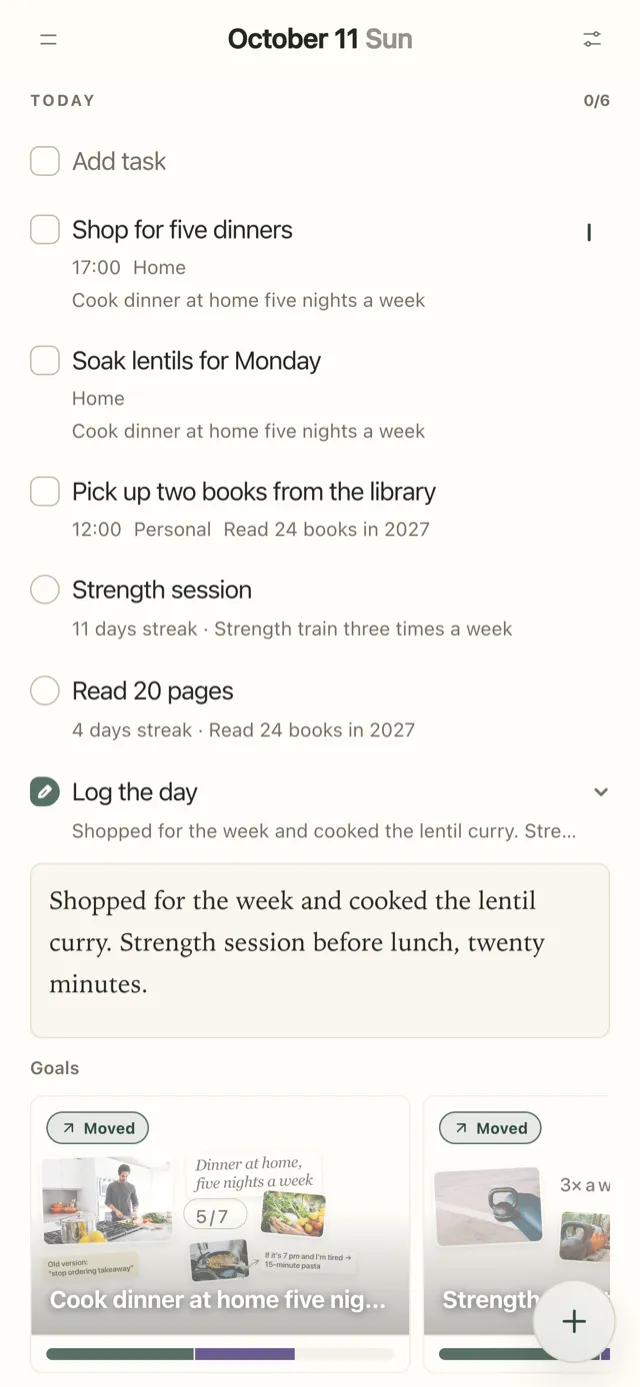
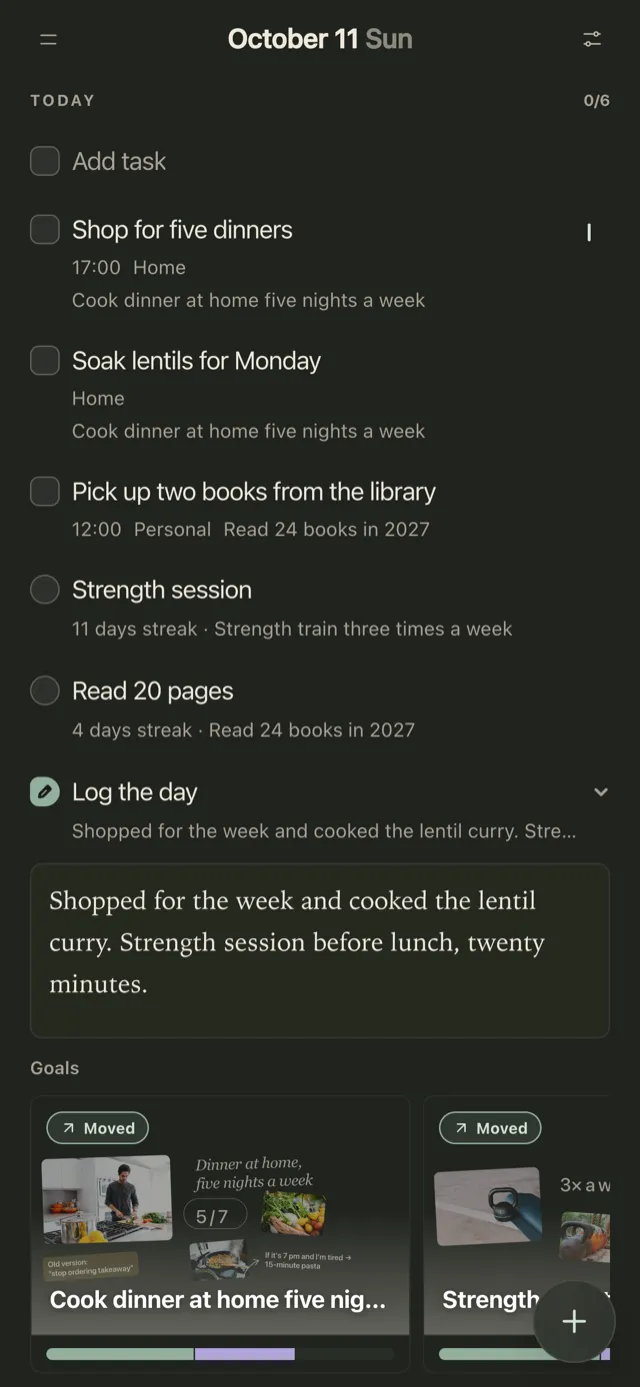
Each resolution becomes a goal with its own board, a deadline (a year, a quarter or a month) and a line about why it matters. The board is where the photo, the obstacle and the if-then plan go. The daily or weekly action becomes a habit with its own days, or a few tasks on real dates, and both are linked to the goal through their Goal field.
Every evening, Log the day on the Today page asks one question per goal: Moved, Thought or Not today. Ticking a linked habit or task answers it for you. Under each board, a 28-day ribbon shows which resolutions you’re working on and which are only on your mind, and the Habits screen shows the last four weeks, three months or a year at a glance.
The details are in Connect tasks and habits to a goal, Habits and streaks and The evening check-in. If you’re still choosing what to aim for, there are more than sixty specific ideas in 2027 Vision Board Ideas. The Free plan covers one goal with a full board and three habits, which is enough for one resolution done properly.
FAQ
What percentage of people keep their New Year’s resolutions?
In Norcross and Vangarelli’s 1988 study, 77% kept their resolution for a week, 55% for a month, 40% for six months and 19% for two years. A 2020 Swedish study of 1,066 people found that 55% considered themselves successful after a full year. People who make a resolution do far better than people who want to change but don’t commit: 46% against 4% at six months in a 2002 study.
When do most people give up on New Year’s resolutions?
The biggest drop happens in the first month. Strava’s activity data puts its “Quitter’s Day” in the second or third week of January most years, and in the 1988 study the share still keeping their resolution fell from 77% after one week to 55% after one month.
How long does it take for a resolution to become a habit?
In Phillippa Lally’s 2010 study, the median time for a new daily behaviour to feel automatic was 66 days, with a range from 18 to an estimated 254 days. Missing a single day didn’t materially change the result.
What’s the best way to word a New Year’s resolution?
As something to start rather than something to stop. In the 2020 Swedish study, approach-oriented resolutions succeeded 58.9% of the time against 47.1% for avoidance-oriented ones. Make it specific enough to schedule: “strength train on Monday, Thursday and Sunday” rather than “get fit”.
Is it worth making New Year’s resolutions at all?
Yes. The fresh start of a new year makes people more likely to begin, and in the 2002 study resolvers were more than ten times as likely to be succeeding at six months as people who wanted to change but didn’t make a resolution.
What should I do if I break my resolution in January?
Restart on the next Monday or the first of the next month, and make the action smaller if it was too ambitious. One missed day or week doesn’t undo a habit that’s forming, but treating it as the end does.
Studies mentioned
- Norcross, J. C., & Vangarelli, D. J. (1988). The resolution solution: Longitudinal examination of New Year’s change attempts. Journal of Substance Abuse, 1(2), 127-134.
- Norcross, J. C., Mrykalo, M. S., & Blagys, M. D. (2002). Auld lang syne: Success predictors, change processes, and self-reported outcomes of New Year’s resolvers and nonresolvers. Journal of Clinical Psychology, 58(4), 397-405.
- Oscarsson, M., Carlbring, P., Andersson, G., & Rozental, A. (2020). A large-scale experiment on New Year’s resolutions: Approach-oriented goals are more successful than avoidance-oriented goals. PLOS ONE, 15(12), e0234097.
- Dai, H., Milkman, K. L., & Riis, J. (2014). The fresh start effect: Temporal landmarks motivate aspirational behavior. Management Science, 60(10), 2563-2582.
- Gollwitzer, P. M., & Sheeran, P. (2006). Implementation intentions and goal achievement: A meta-analysis of effects and processes. Advances in Experimental Social Psychology, 38, 69-119.
- Lally, P., van Jaarsveld, C. H. M., Potts, H. W. W., & Wardle, J. (2010). How are habits formed: Modelling habit formation in the real world. European Journal of Social Psychology, 40(6), 998-1009.
- Milkman, K. L., Minson, J. A., & Volpp, K. G. M. (2014). Holding the Hunger Games hostage at the gym: An evaluation of temptation bundling. Management Science, 60(2), 283-299.
- Amabile, T., & Kramer, S. (2011). The Progress Principle. Harvard Business Review Press.
- Oettingen, G. (2014). Rethinking Positive Thinking: Inside the New Science of Motivation. Current.
Photo credits
The photos on the example boards come from Unsplash: Jason Briscoe, Jan Kraus and Christian Lue (cooking), Content Pixie and Richard R (strength), Alexandra Fuller and Debby Hudson (reading).