Evening and Night Routine Checklist: 40 Ideas (+ Printable)
An evening and night routine checklist with an example routine, 40 ideas, what research says about planning tomorrow and sleep, and a free printable.
A good evening routine has two parts. First you end the day, so unfinished work stops circling in your head. Then you wind down and go to bed at the same time every night. Everything else on an evening or night routine checklist, the tidying, the shower, the book, belongs to one of those two.
Below is an example evening routine, what research says about how it works, how to build your own so it lasts, 40 ideas, and a free printable with a page for each part.
Evening routine checklist: an example
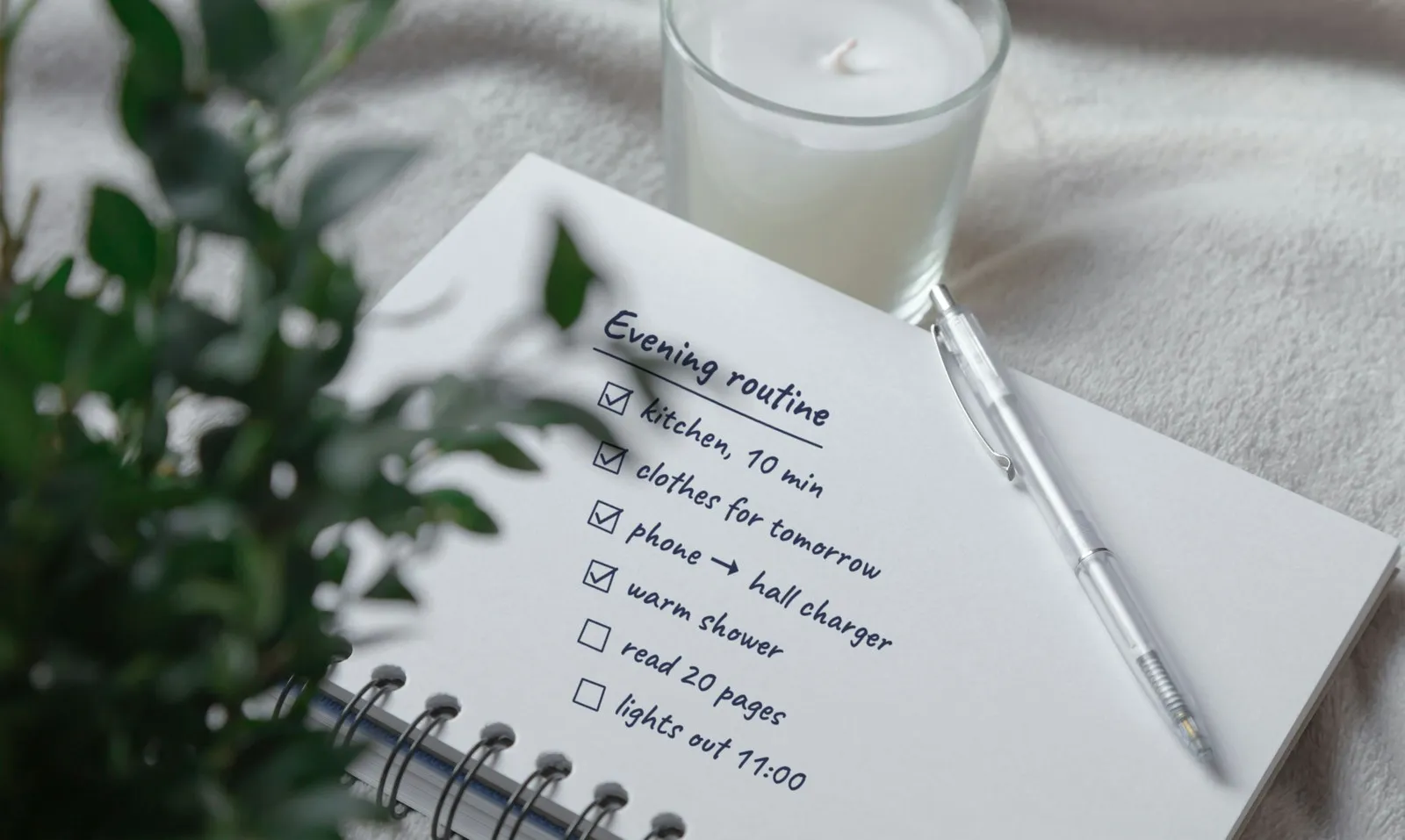
Here’s an evening for someone who goes to bed at 10:30. The steps take about an hour in all, spread over the evening. Work back from your own lights-out time; the order matters more than the clock.
| When | Step | Part |
|---|---|---|
| After the dishes | Tidy the kitchen, 10 minutes | End the day |
| 8:45 pm | Tick off what’s done, move what’s left, write one line about today | End the day |
| 8:50 pm | Choose tomorrow’s first task and give it a time | End the day |
| 9:00 pm | Lay out tomorrow’s clothes and pack the bag | End the day |
| 9:30 pm | Screens off; the phone charges outside the bedroom | Wind down |
| 9:30 pm | A warm shower | Wind down |
| 9:45 pm | Read a paper book | Wind down |
| 10:30 pm | Lights out, at the same time every night | Wind down |
The point is to keep it short enough to do when you’re tired. Three steps you do every night beat ten you do on Sundays. If the full version is too much, start with one line about today, screens off and lights out, and add a step a week.
Part 1: end the day
What often keeps people awake isn’t the day itself but what’s left of it: the email you didn’t send, the thing due on Thursday. Ending the day means giving each open item a place, so your head doesn’t have to hold it overnight.
Writing down tomorrow helps you fall asleep. In a sleep-lab study by Michael Scullin and colleagues, 57 young adults spent five minutes before lights out writing either a to-do list for the coming days or a list of what they had already done. The to-do list group fell asleep about nine minutes faster, and the more specific the list, the faster they fell asleep.
A plan lets your mind put a goal down. E. J. Masicampo and Roy Baumeister found that unfinished goals keep intruding on people’s thoughts, but making a specific plan for them was enough to quiet those intrusions, even before the goal was done. “Call the bank” circles; “call the bank at 9:15 tomorrow” doesn’t.
So this part of the routine is short and concrete:
- Tick off what you finished.
- Give everything still open a new day, or delete it.
- Write one line about how the day went.
- Choose tomorrow’s first task and give it a time.
It takes two to five minutes. The full ten-minute version, with what to put on tomorrow’s list, is in how to plan your day the night before. If your head is still racing after that, a quick brain dump on paper empties the rest.
Part 2: a night routine to wind down before bed
The second half of the evening is about getting to bed at the same time each night, ready to sleep. Three findings are worth building around.
A regular bedtime matters. In a study of 60,977 adults in the UK Biobank who wore activity trackers, Daniel Windred and colleagues found that people with the most regular sleep schedules had a 20 to 48% lower risk of death from any cause than the least regular fifth, and regularity predicted it better than how long people slept. It’s an observational study, so it shows a link, not proof. Still, it’s a good reason to make lights-out the fixed point of the routine and to keep it on weekends.
Screens push sleep a little later. In a lab study by Anne-Marie Chang and colleagues, 12 young adults read for about four hours before bed on an iPad or from a printed book, five evenings in a row each. After the iPad, they took about 10 minutes longer to fall asleep, their melatonin rose about 90 minutes later, and they were groggier the next morning, although their total sleep didn’t change. The effect is modest, but a bright screen right before bed does nudge the body clock later. Blue-light glasses aren’t a proven fix: a 2023 Cochrane review found too little good evidence to say whether they help sleep. Putting the phone away at a set time, outside the bedroom, is simpler.
A warm shower 1 to 2 hours before bed. A 2019 review of 17 studies by Shahab Haghayegh and colleagues found that a warm shower or bath, around 40 to 42.5 °C (104 to 108.5 °F) and as short as 10 minutes, taken 1 to 2 hours before bed, was linked to falling asleep faster and better sleep quality. So the shower belongs early in the wind-down, not just before getting under the covers.
How to build an evening routine that sticks
- Pick your lights-out time first. Count back seven to eight hours from when you need to get up. Everything else is arranged before it.
- Start it after something you already do. “After I load the dishwasher” is a better trigger than a clock time, because it already happens every evening.
- Keep the same order. A routine you don’t have to think about is one you can do tired: end the day, get tomorrow ready, screens off, shower, read, lights out.
- Start with three steps. Add one a week once the first three are automatic. Habits take a while: in Phillippa Lally’s study of everyday habits, it took a median of 66 days for a new one to feel automatic, as we cover in how long it takes to form a habit.
- Keep a short version for late nights. One line about today and lights out. Doing the short version keeps the habit alive on nights when the full one isn’t possible.
- Keep weekends close to weekdays. An hour later is fine; three hours later is a new time zone every Monday.
Mornings work the same way. Our morning routine checklist builds the other end of the day around an anchor too.
40 evening routine ideas
Pick a few from different groups, not everything from one.
End the day
- Tick off what you finished today
- Move what’s left to another day, or delete it
- Write one line about how the day went
- Choose tomorrow’s first task and give it a time
- Empty your head onto paper if it’s racing
- Write down three things that went well
- Check tomorrow’s calendar for early meetings
Reset the house
- Tidy the kitchen for 10 minutes
- Start the dishwasher
- Clear one surface completely
- Take out the trash and recycling
- Tidy the living room while the kettle boils
- Water the plants
- Set out what you need for breakfast
Get tomorrow ready
- Lay out tomorrow’s clothes
- Pack your work or gym bag
- Prepare lunch or overnight oats
- Put keys, wallet and badge in one place
- Fill a water bottle
- Leave the first task open on your desk
Look after your body
- A walk after dinner
- Ten minutes of gentle stretching
- A warm shower 1 to 2 hours before bed
- Skincare and teeth at the same time each night
- A cup of herbal tea
- Lay out your running shoes for the morning
Slow your mind down
- Read a paper book for 20 minutes
- Journal one line, or a page (how to start journaling)
- Listen to music you know well
- Talk with your partner, without screens
- Breathing: in for four, out for six, for a few minutes
- Plan one thing to look forward to tomorrow
Set up for sleep
- Screens off at a set time
- The phone charges outside the bedroom
- Set the alarm, then put the phone away
- Dim the lights an hour before bed
- Keep the bedroom cool
- Keep a notepad by the bed for anything that pops up
- If you can’t sleep after a while, get up and read in dim light until you’re sleepy
- Same lights-out time every night, weekends within an hour
Evening routine with ADHD
Evenings are where routines usually fall apart with ADHD: focus arrives at 10 pm, and time disappears. Two things help more than willpower. Put the cues outside your head: an alarm for screens off, the phone charger in another room. And keep the routine to three steps, written where you’ll see them. Our ADHD planner guide covers the daily planning side.
Common evening routine mistakes
- Too many steps. Ten steps is a project, not a routine. Three to six is plenty.
- No fixed lights-out time. Without it, the routine just slides later with the evening.
- Skipping tomorrow’s plan. Unfinished tasks follow you to bed if they have nowhere to go.
- Screens in bed “for a minute.” The phone always wins that negotiation. Charge it elsewhere.
- A different routine every weekend. Keep it within an hour, or Monday mornings will feel like jet lag.
- Giving up after a missed night. One missed evening doesn’t erase the habit. Do the short version the next night.
Free evening routine checklist printable
The printable has a page for each part. Page 1 is the wind-down: the anchor, screens-off and lights-out times, eight steps with a ring for each night of the week, and the short version for late nights. Page 2 ends the day, a row per night: one line about today, what tomorrow starts with, and the time the lights actually went out.
An evening routine in Plannedo
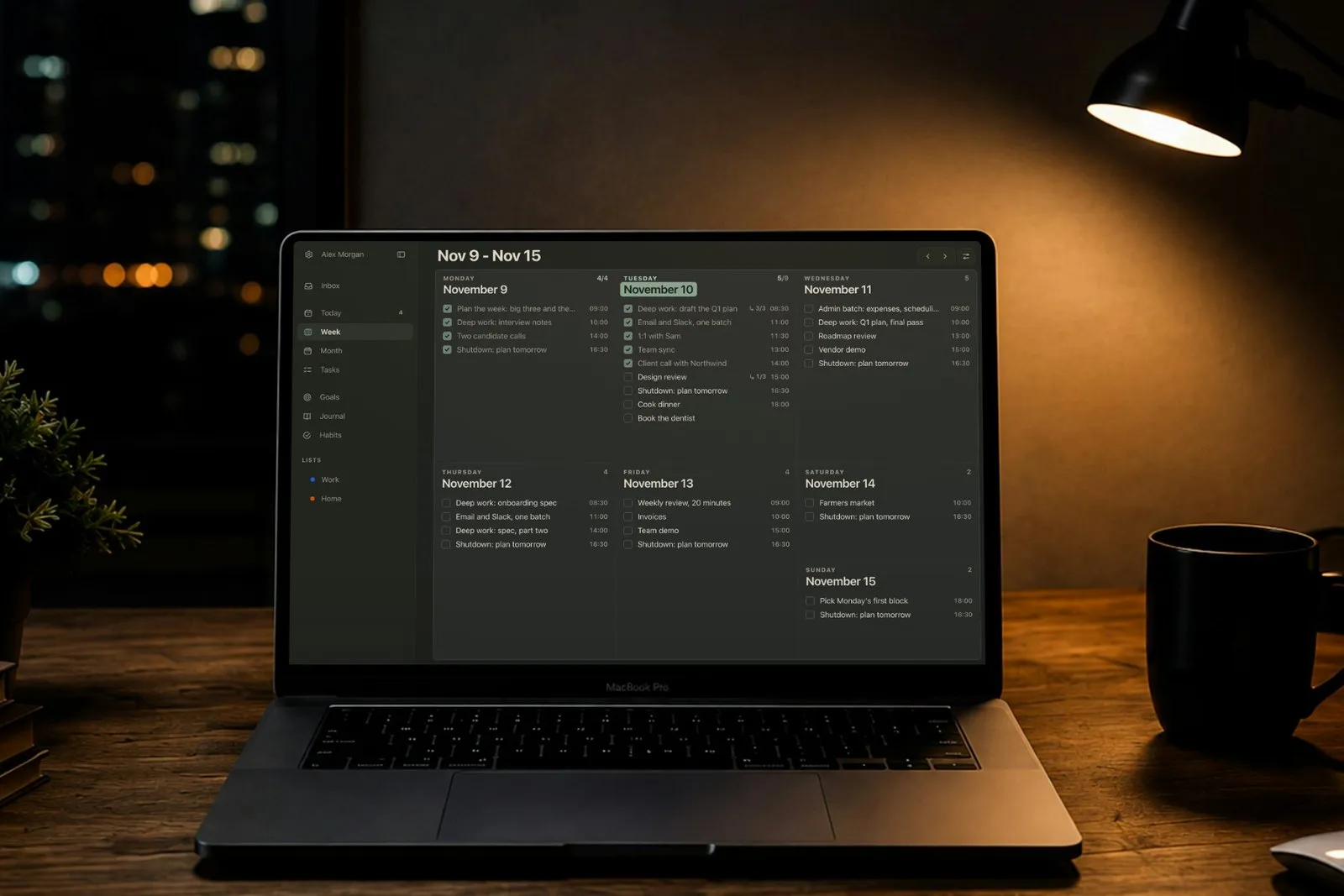
The first part is what Plannedo’s Today page is made for. In the evening, you tick off what’s done, move what’s left to another day, write one line in Log the day, and put tomorrow’s first task on the next day with a time. The second part is a set of habits: each wind-down step becomes a daily habit that shows up on Today with its streak, and you tick them off as you go.
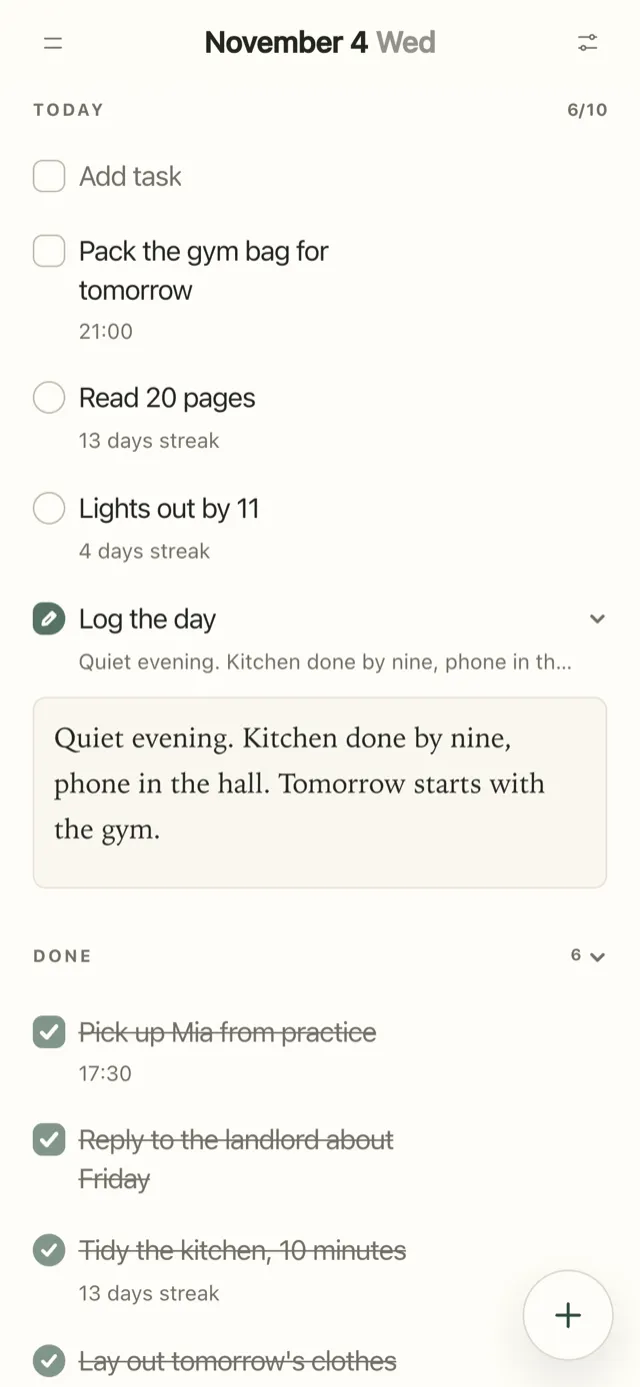
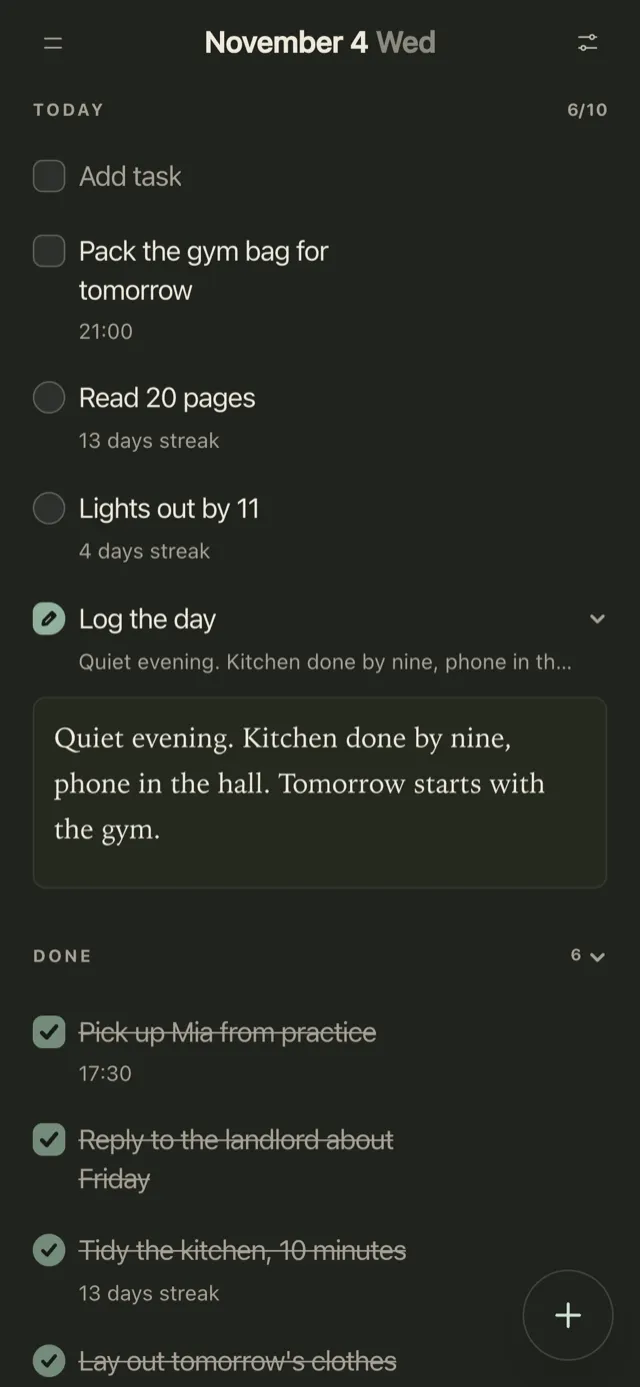
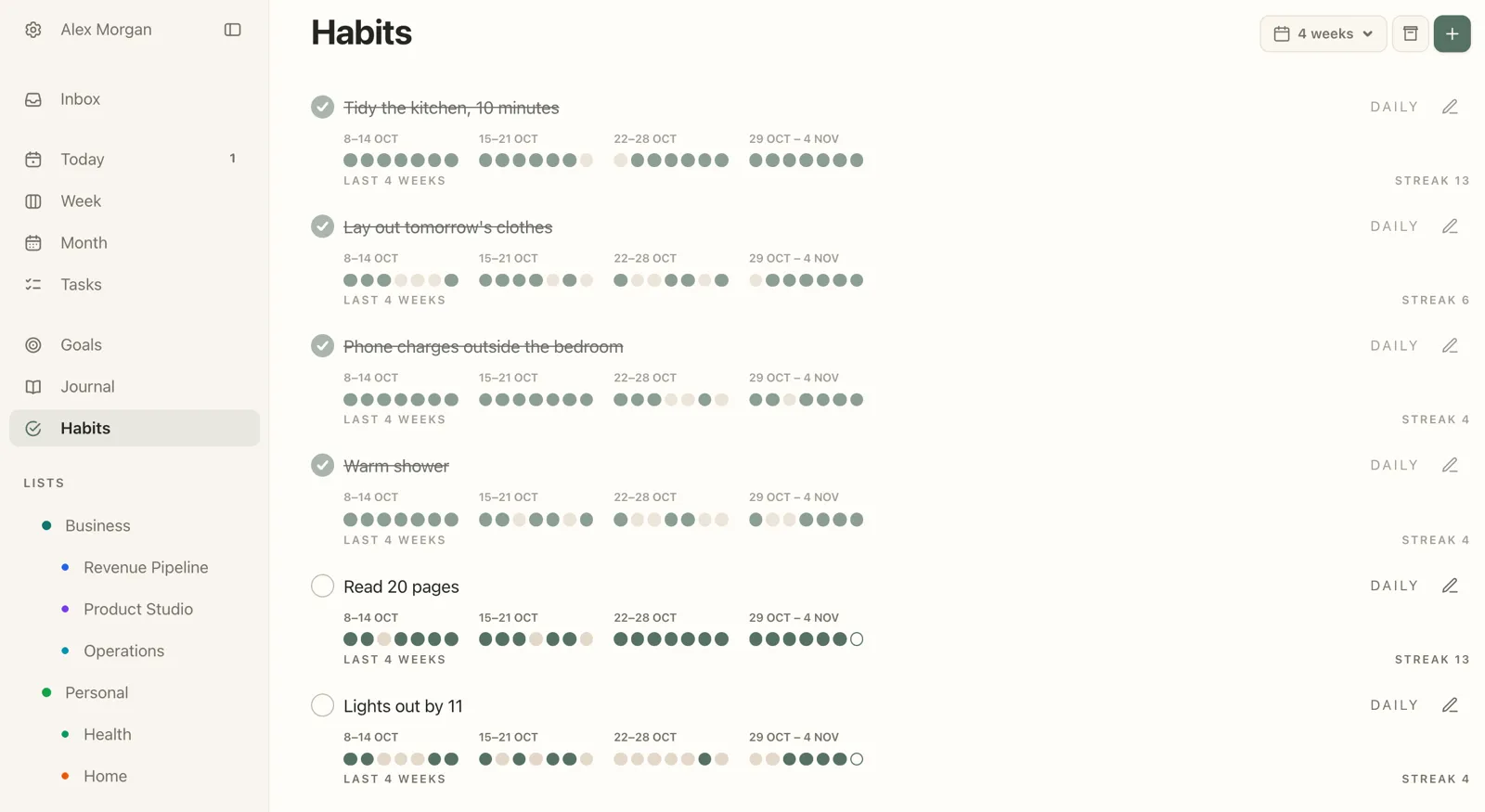
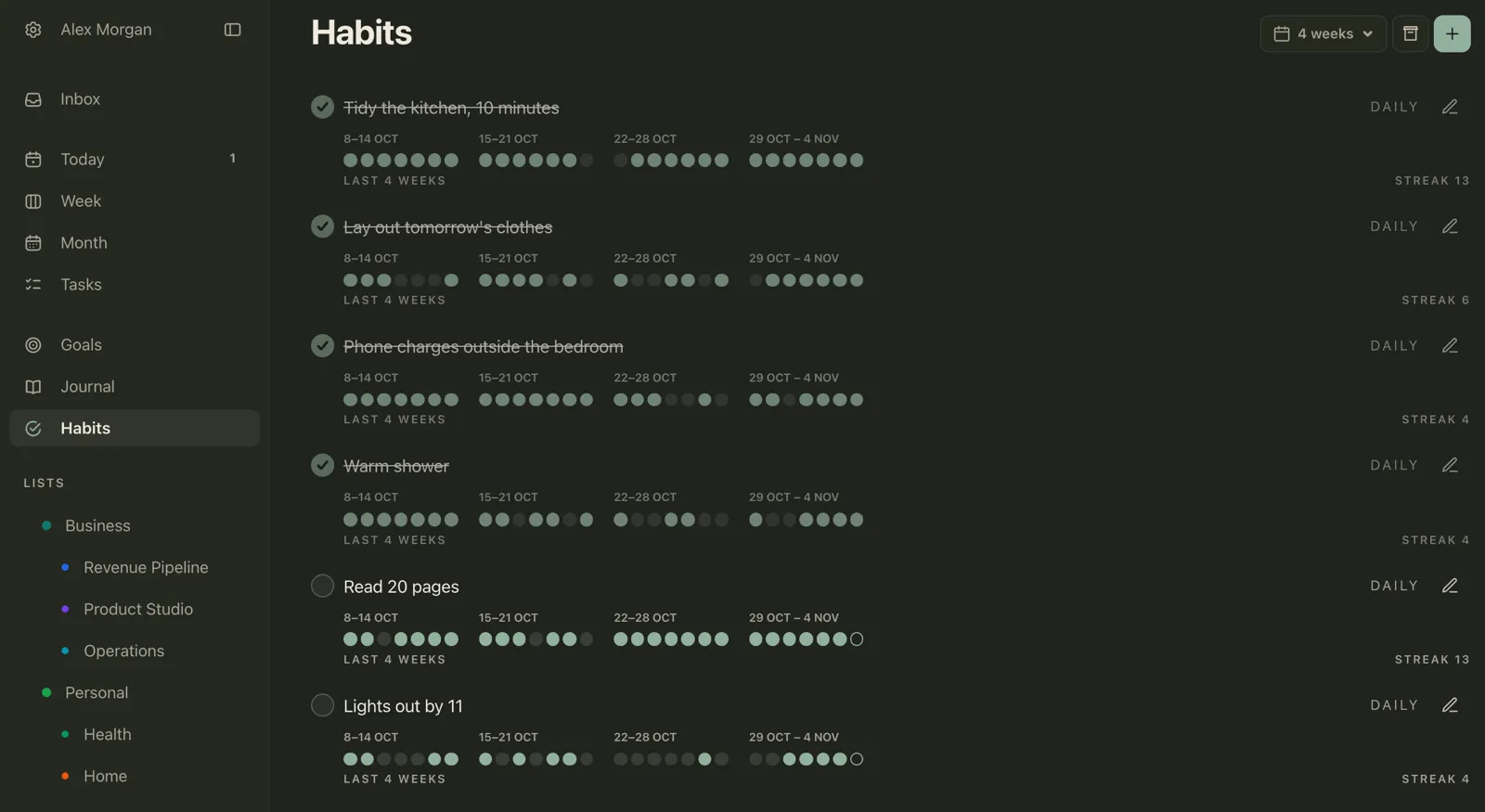
The Habits screen shows each step’s last four weeks as dots, so you can see which part of the routine holds and which one slips. In the example, reading happens almost every night, and lights out by 11 is the step to work on.
With Settings → Daily reminders, an evening reminder at the time you choose opens Today, so starting the routine is one tap (reminders are part of Pro). The free plan includes three habits, which is the right size for a first routine. More in the help centre: habits and streaks, the evening check-in and daily reminders.
FAQ
What should be on an evening routine checklist?
Two kinds of steps. Ending the day: tick off what’s done, move what’s left, write one line about today and choose tomorrow’s first task. Winding down: screens off at a set time, something calm like a warm shower or a paper book, and the same lights-out time every night. Start it after something you already do, like the dinner dishes.
How long should an evening routine take?
Between 20 minutes and an hour. Ending the day takes two to five minutes; winding down can be as short as screens off and lights out. A short routine you do every night works better than a long one you skip.
What time should I start my evening routine?
Work back from your lights-out time. End the day about two hours before bed, put the warm shower 1 to 2 hours before, and turn screens off 30 to 60 minutes before lights out.
Why plan tomorrow before bed?
Unfinished tasks keep coming back to mind until they have a plan. In a sleep-lab study, people who wrote a specific to-do list for the coming days before bed fell asleep about nine minutes faster than people who wrote about what they had already done.
Should I stop using my phone before bed?
It helps to put it away at a set time and charge it outside the bedroom. In a lab study, four hours of reading on an iPad before bed delayed sleep by about 10 minutes and left people groggier the next morning compared with a paper book, though total sleep didn’t change.
Is a warm shower before bed good for sleep?
Yes, if the timing is right. A review of 17 studies linked a warm shower or bath of about 40 to 42.5 °C, taken 1 to 2 hours before bed, with falling asleep faster and better sleep quality.
Why does a regular bedtime matter?
In a study of about 61,000 adults who wore activity trackers, people with the most regular sleep schedules had a lower risk of early death, and regularity mattered more than how long they slept. Keeping lights-out within an hour, weekends included, is the simplest way to get there.
Is there an app for an evening routine?
Yes. Plannedo, a planner for iPhone, Mac and the web, keeps each step of the routine as a daily habit with its streak on the Today page, next to the day’s tasks and a one-line journal, so ending the day and winding down happen in one place. The free plan includes three habits and unlimited tasks.
What’s the difference between an evening routine and a night routine?
They’re mostly the same thing. An evening routine often starts earlier, right after dinner, with ending the day and getting tomorrow ready; a night routine or bedtime routine usually means the last 30 to 60 minutes before sleep.
Studies mentioned
- Chang, A.-M., Aeschbach, D., Duffy, J. F., & Czeisler, C. A. (2015). Evening use of light-emitting eReaders negatively affects sleep, circadian timing, and next-morning alertness. Proceedings of the National Academy of Sciences, 112(4), 1232-1237.
- Haghayegh, S., Khoshnevis, S., Smolensky, M. H., Diller, K. R., & Castriotta, R. J. (2019). Before-bedtime passive body heating by warm shower or bath to improve sleep: A systematic review and meta-analysis. Sleep Medicine Reviews, 46, 124-135.
- Lally, P., van Jaarsveld, C. H. M., Potts, H. W. W., & Wardle, J. (2010). How are habits formed: Modelling habit formation in the real world. European Journal of Social Psychology, 40(6), 998-1009.
- Masicampo, E. J., & Baumeister, R. F. (2011). Consider it done! Plan making can eliminate the cognitive effects of unfulfilled goals. Journal of Personality and Social Psychology, 101(4), 667-683.
- Scullin, M. K., Krueger, M. L., Ballard, H. K., Pruett, N., & Bliwise, D. L. (2018). The effects of bedtime writing on difficulty falling asleep: A polysomnographic study comparing to-do lists and completed activity lists. Journal of Experimental Psychology: General, 147(1), 139-146.
- Singh, S., Keller, P. R., Busija, L., McMillan, P., Makrai, E., Lawrenson, J. G., Hull, C. C., & Downie, L. E. (2023). Blue-light filtering spectacle lenses for visual performance, sleep, and macular health in adults. Cochrane Database of Systematic Reviews, 2023(8), CD013244.
- Windred, D. P., Burns, A. C., Lane, J. M., Saxena, R., Rutter, M. K., Cain, S. W., & Phillips, A. J. K. (2024). Sleep regularity is a stronger predictor of mortality risk than sleep duration: A prospective cohort study. Sleep, 47(1), zsad253.
Photo credits
The cover photo is by Diana Polekhina on Unsplash.