How to Be Productive: 12 Hacks That Actually Work
How to be productive, according to research: 12 habits that hold up, from if-then plans and doing the important task first to email in rounds, breaks and sleep, plus the popular productivity hacks that turned out to be myths.
How to be productive, in one paragraph: the evening before, pick the one or two things that matter most and give each a time. Start the day with them, before email. Check messages in a few set rounds, take short breaks, sleep enough, stop at a reasonable hour, and write down what you got done. Almost all of it is decided before the work starts.
We build a planner, so we read a lot of productivity advice. Most of it is somebody’s habit presented as a law. Below are 12 habits with research behind them, with a note on how strong it is; the productivity hacks that didn’t hold up; an example day and week; and an honest answer to how many hours of real work you can expect from a day.
What does it mean to be productive?
Being productive means getting the important things done, not being busy. A day with sixty answered emails can feel full and move nothing. A day with two quiet hours on the proposal that’s due moves your work forward, even if the inbox is still at forty.
It’s also as much about a calmer day as about output. A 2021 meta-analysis of 158 studies by Brad Aeon, Aïda Faber and Alexandra Panaccio found that time management goes with better job performance (r = .26), and more strongly with well-being (.31) and life satisfaction (.43). Keep that in mind when a technique promises to double your output: the realistic gain is a day that feels more under control and finishes the right things.
How to be productive: 12 hacks that actually work
None of these are clever. They’re plain habits, roughly in the order of a day: before it starts, while it runs, and after it ends.
1. Pick one or two things that matter, and make them specific
Most days have room for one or two pieces of real work. Choose them before anything else, and name them so you’ll know when they’re done: “write the recommendation for the pricing proposal” rather than “work on pricing”.
In the research Edwin Locke and Gary Latham reviewed over 35 years, specific, challenging goals led to better performance than “do your best”. For new or complex work, the same research favors a near-term sub-goal, such as the first section or a rough draft, over one big outcome. And keep the list short. In Amy Dalton and Stephen Spiller’s experiments, detailed plans helped people complete one goal, but not six. More on choosing in how to set goals.
2. Give them a time and a place
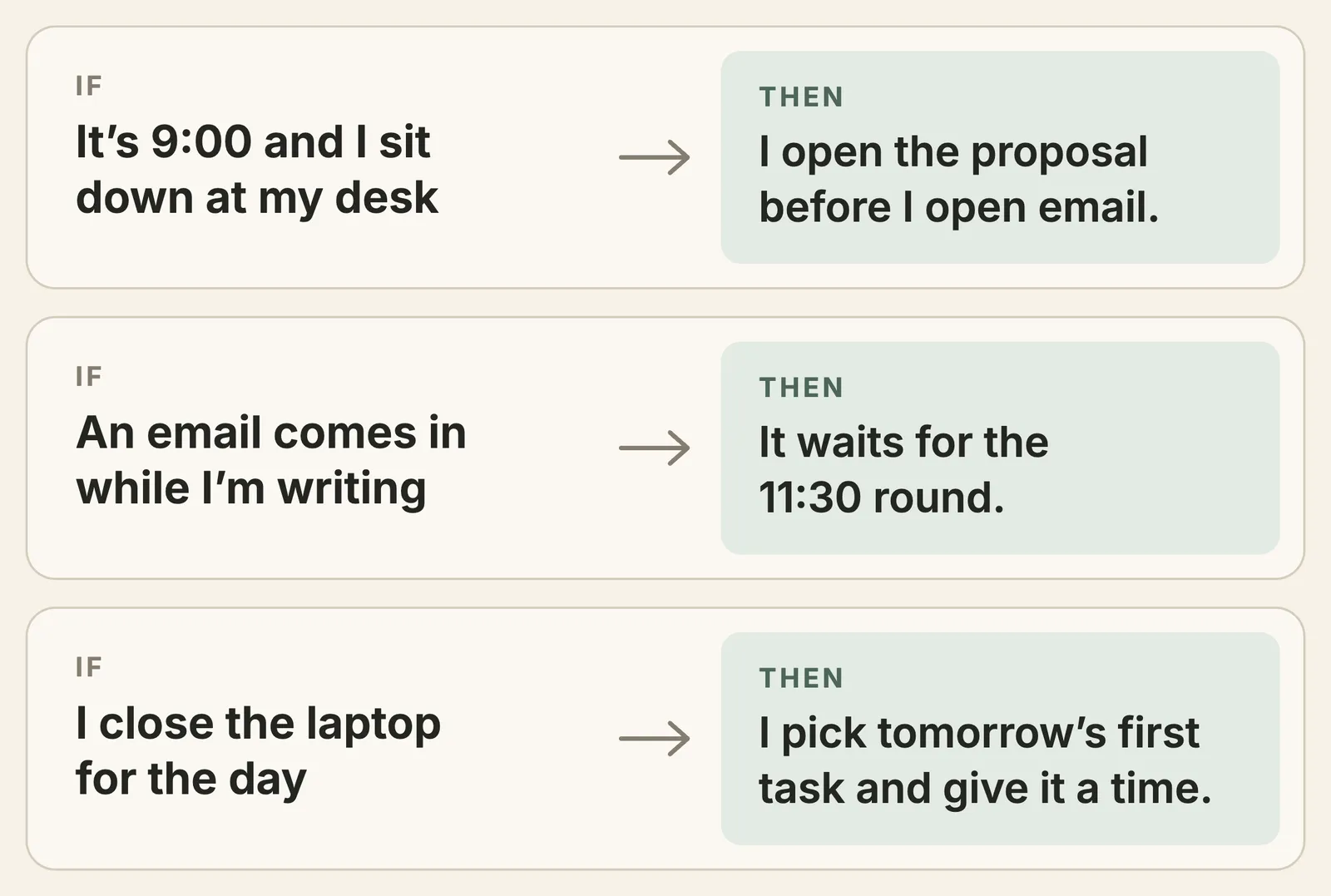
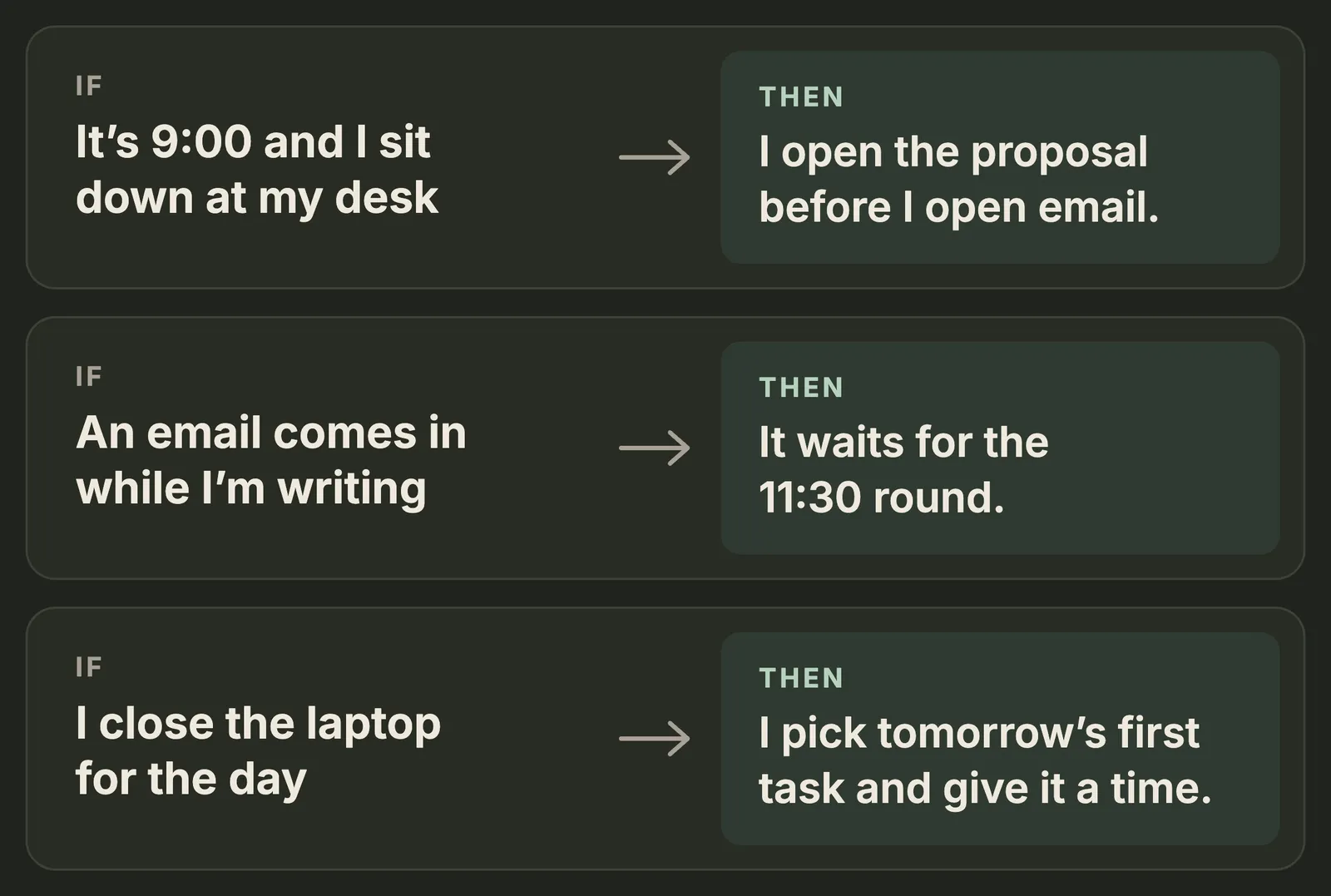
“I’ll do the proposal tomorrow” leaves the hardest decision, when, for later. Make it now, in an if-then form: “At 9:00, when I sit down at my desk, I open the proposal before email.” Psychologists call these implementation intentions, and they’re the most studied planning habit there is.
The latest meta-analysis, by Paschal Sheeran, Olivia Listrom and Peter Gollwitzer, pooled 642 tests. The effect is reliable but smaller than older reviews suggested (d = .36 on average, and about .15 after correcting for publication bias), and the details matter. Plans with both a time and a place did better than plans with a time only (d = .46 against .25). Adding how or for how long didn’t help further.
3. Plan tomorrow before you stop today
End the workday by choosing tomorrow’s first task and giving it a time. It saves the best minutes of the morning from deciding, and it helps you stop thinking about work.
In E. J. Masicampo and Roy Baumeister’s experiments, an unfinished goal kept intruding on people’s thoughts until they made a specific plan for it. Brandon Smit found something similar at work: an end-of-day plan for unfinished goals helped people switch off in the evening, mostly those who usually find it hardest. And in a sleep-lab study by Michael Scullin and colleagues, people who wrote a specific to-do list at bedtime fell asleep in about 16 minutes, against 25 for people who wrote about what they’d already done. The full routine is in our guide to planning your day the night before.
4. Expect everything to take longer
Whatever you plan will take longer than you think, and knowing it doesn’t fix it. In Roger Buehler, Dale Griffin and Michael Ross’s classic study, students expected to finish their honors thesis in 34 days and took 56. Fewer than half finished even by their own worst-case date.
Two things help. List the steps before you estimate, which works best for tasks with many parts (Justin Kruger and Matt Evans). And note how long things really took, because memory shrinks past tasks, so the next estimate starts from a real number. In practice, plan less than the day holds: we leave about a third of it empty for overruns and for things nobody planned.
5. Start with the important task, not the easy ones
It’s tempting to warm up with small things: clear a few emails, tick something off. The warm-up tends to eat the morning.
Maria Ibanez and colleagues studied 2.4 million diagnoses by radiologists who could choose the order of their queue. Doctors who skipped ahead to the cases they expected to finish fastest were less productive overall, and picking the shortest tasks first was especially costly. The easy tasks will still be there at 11:30. If you like the phrase, that’s eating the frog, though the Mark Twain line it’s credited to is apocryphal (see the myths below).
6. Do one thing at a time, and leave a note when you stop
Every switch between tasks costs time, and more so as the tasks get more complex (Joshua Rubinstein, David Meyer and Jeffrey Evans). Sophie Leroy showed that part of your attention stays on the task you just left, which she called attention residue, and that it hurts the next task.
Her later work with Theresa Glomb found a simple fix for switches you can’t avoid. Before you leave a task, write a line on where you are and what comes next. That ready-to-resume note reduced the residue and protected performance on whatever interrupted you.
7. Check email and messages in rounds
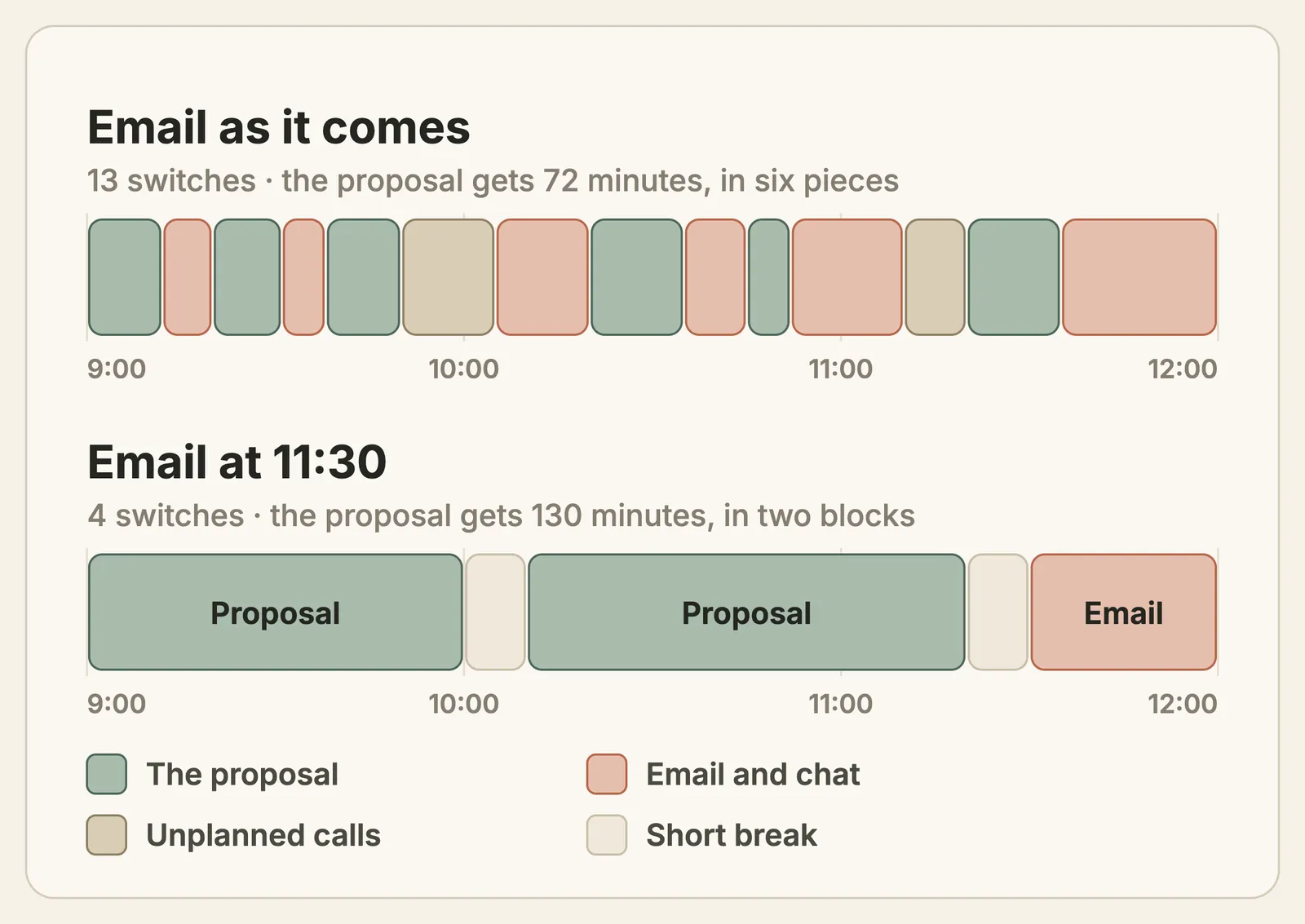
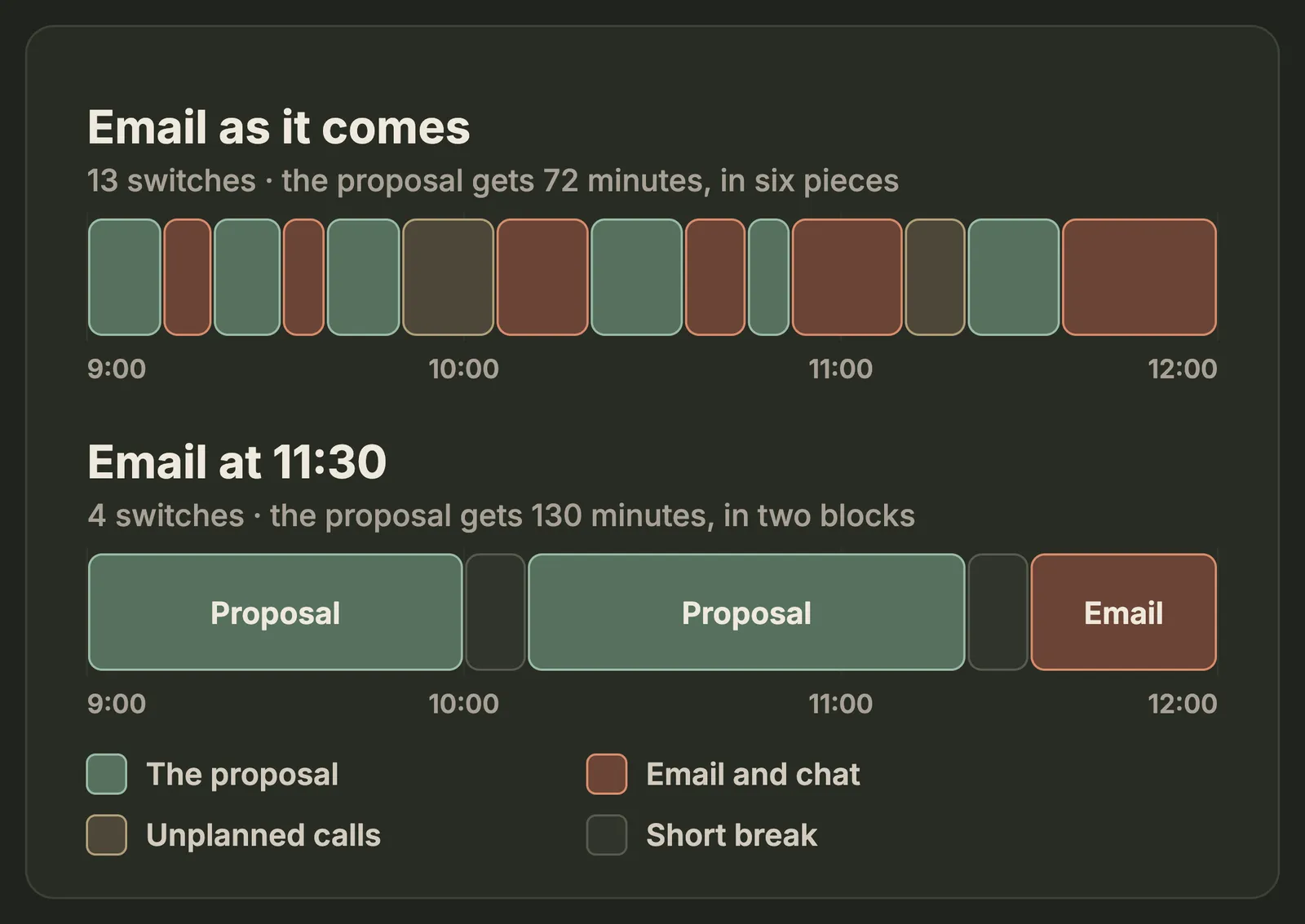
Email and chat are other people’s priorities arriving one at a time. In a field experiment by Kostadin Kushlev and Elizabeth Dunn, 124 adults spent one week checking email only three times a day and another week as often as they liked. In the limited week they checked about 5 times a day instead of 12, and reported less daily stress. Their self-rated productivity didn’t change, which is fair: the gain is a calmer day more than a faster one.
Notifications work the same way. In another study by Kushlev’s group, people reported more inattention in a week with phone alerts on than in a week with them off. So choose two or three times for email and chat, put them in the plan, and turn alerts off in between.
8. Plan for interruptions, not only tasks
A plan made only of tasks breaks on the first interruption. In a two-week study of 187 employees by Michael Parke and colleagues, listing and scheduling the day’s tasks raised engagement and performance, except on days full of interruptions. A second kind of planning helped either way: thinking ahead about what’s likely to interrupt you and how you’ll handle it.
So add a line for that: “If Maya calls during the proposal, I’ll ask to talk at 14:00.” And expect a price when it happens anyway. In Gloria Mark’s lab study, interrupted people finished their tasks just as well, but faster and under more stress.
9. Take short breaks, for energy more than output
Breaks of ten minutes or less make people feel more energetic and less tired, according to a 2022 meta-analysis of 22 samples by Patricia Albulescu and colleagues (d = .36 for vigor and .35 for fatigue). Their effect on performance was small and not significant overall: clearer on routine tasks than on demanding ones, and bigger for longer breaks.
So take breaks to stay fresh, without expecting a five-minute pause to write the report for you. A walk is a good choice: in Marily Oppezzo and Daniel Schwartz’s experiments at Stanford, people came up with more creative ideas while walking than while sitting.
10. Protect your sleep
Sleep quietly decides the rest of this list. In a lab study by Hans Van Dongen and colleagues, healthy adults who slept 6 hours a night for two weeks ended up with attention lapses as bad as after a full night without sleep. Those on 4 hours ended up as bad as after two nights. By the end, both groups rated themselves only slightly sleepy.
Across 147 tests reviewed by Julian Lim and David Dinges, short sleep hit simple attention hardest. If you’re short on sleep, you won’t feel how much it costs, so don’t trust the feeling. Treat a fixed bedtime as part of the plan, not as what’s left after it.
11. Stop at a reasonable hour, and keep a day off
Long hours look productive and often aren’t. John Pencavel reanalyzed data on British munitions workers from the First World War. Up to about 49 hours a week, output rose in step with hours. Beyond that it rose more and more slowly, and output at 70 hours differed little from output at 56. Weeks without a day of rest had about 10% lower output at the same hours.
It’s century-old factory work, not an office, but there’s little reason to expect office work to stretch further. A 2025 study of 2,896 employees in 141 organizations that moved to a four-day week with no cut in pay found less burnout and better mental and physical health, a change not seen in 12 control companies. It measured well-being, not output.
12. Write down what you got done
A list of what you finished is a small habit with good evidence. In a 2016 meta-analysis of 138 experiments with almost 20,000 people, Benjamin Harkin and colleagues found that monitoring progress toward a goal helped people reach it (d = .40), and more so when they wrote the progress down or shared it. In Teresa Amabile and Steven Kramer’s study of nearly 12,000 diary entries from 238 people, making progress on meaningful work, even a small step, was what most often set the best days apart.
At the end of the day, write a line about what moved; a ta-da list is the daily version. Once a week, look back at the whole week with a weekly review.
Productivity hacks that don’t hold up
Some of the most repeated productivity advice comes from a study that failed to replicate, a company blog post or nowhere at all.
| The claim | What the evidence says |
|---|---|
| Willpower is a fuel tank, so save it for what matters | The “ego depletion” effect behind it shrank to almost nothing in two large preregistered replications: d = .04 across 23 labs, and .06 across 36. |
| It takes 23 minutes to refocus after an interruption | The figure comes from a 2006 interview with Gloria Mark. It’s how long people took, on average, to get back to an interrupted task, usually after doing other things in between. That’s the length of the detour, not the time it takes to refocus. |
| Multitasking costs you 40% of your productive time | It’s how much the psychologist David Meyer said switching can cost at most, quoted on an American Psychological Association page, not a measured result. Switching does cost something; the 40% is a ceiling, not a typical number. |
| Work 52 minutes, then break for 17 | It comes from DeskTime’s analysis of its own users’ computer logs, not a peer-reviewed study. DeskTime’s 2021 rerun came out at 112 and 26. |
| The Pomodoro Technique is proven | The only direct test we know of followed 87 university students through one day of study. Fixed breaks left them less tired and more focused than breaks they chose themselves, with the same amount done. Promising, not proof. |
| Work at your peak hour, by chronotype | In a 2023 study, 446 young adults did eight tasks at their best and worst times of day. There was no general boost from matching the time to the person. |
| A phone on your desk drains your brain, even when it’s off | The 2017 “brain drain” study didn’t replicate in a preregistered direct replication in 2022, and meta-analyses since have come to different conclusions. Keep the phone away because of what it interrupts with, not because you can see it. |
| Harvard found that the 3% who wrote down their goals earned ten times more | No such study exists. Harvard Library’s librarians searched for it, and so did Yale’s; Harvard calls it an urban legend. |
| Mark Twain said to eat a live frog every morning | Quote Investigator found no evidence Twain said it; the saying probably goes back to the French writer Nicolas Chamfort. The advice itself, doing the important task first, does have support (habit 5). |
How to plan a productive day
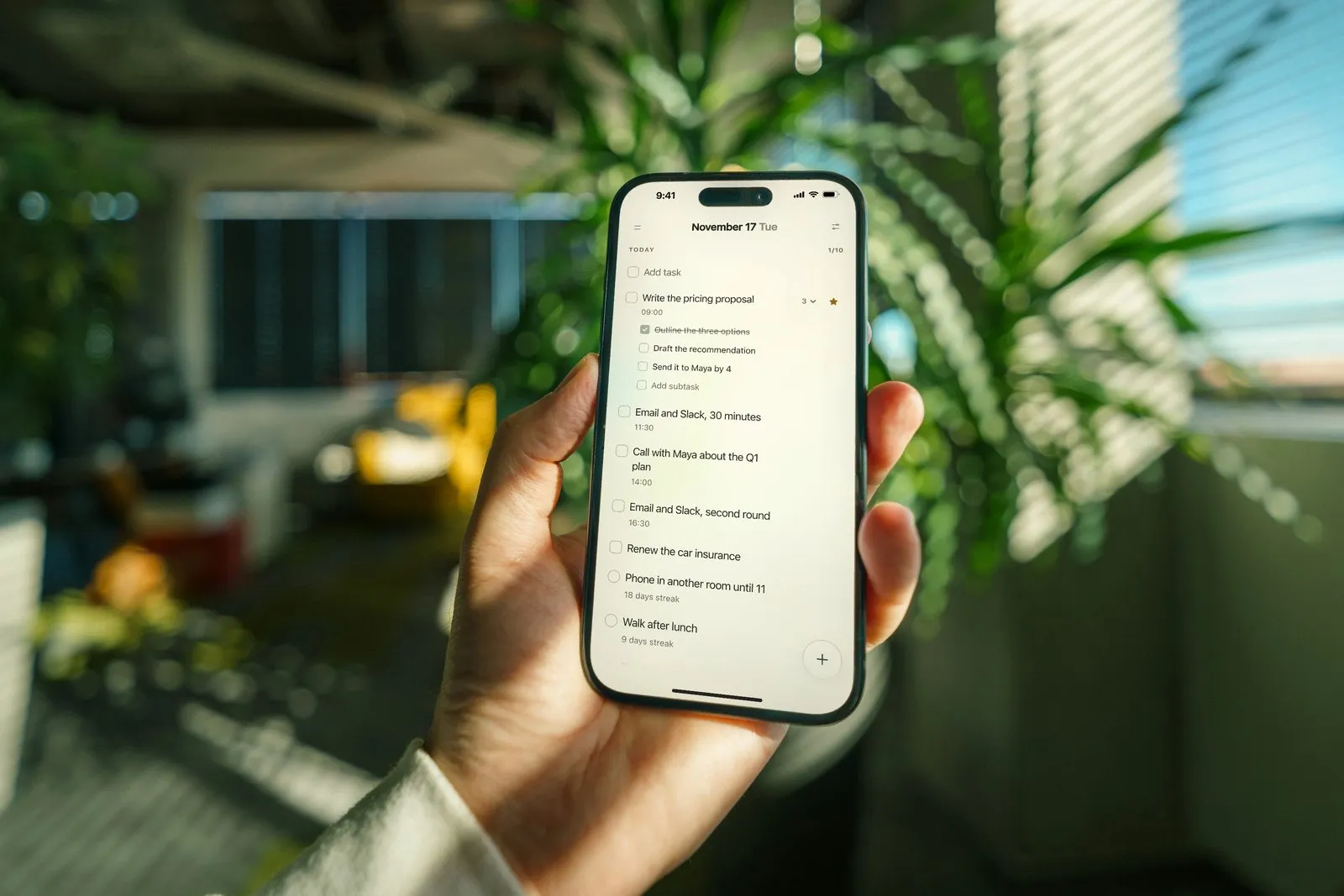
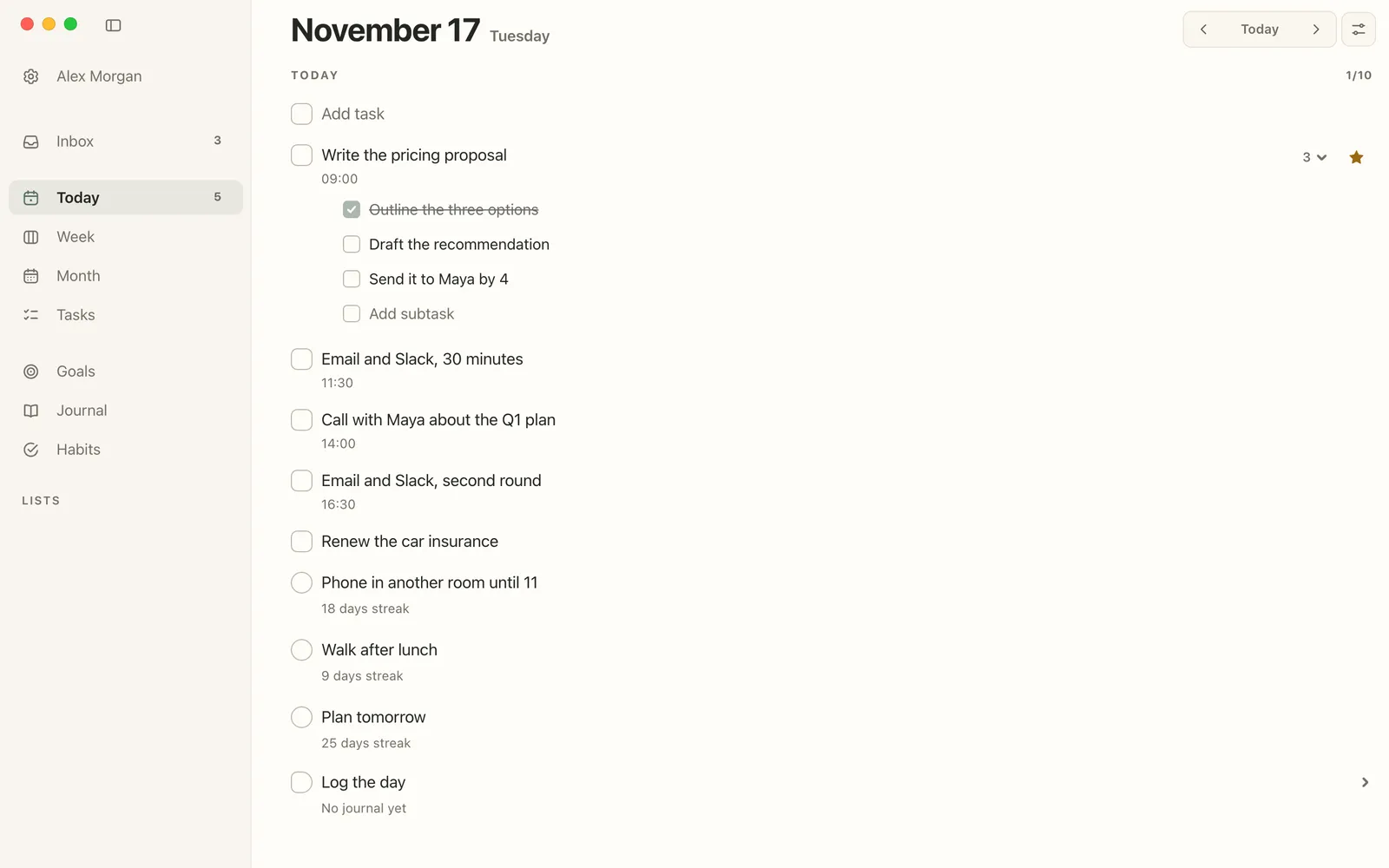
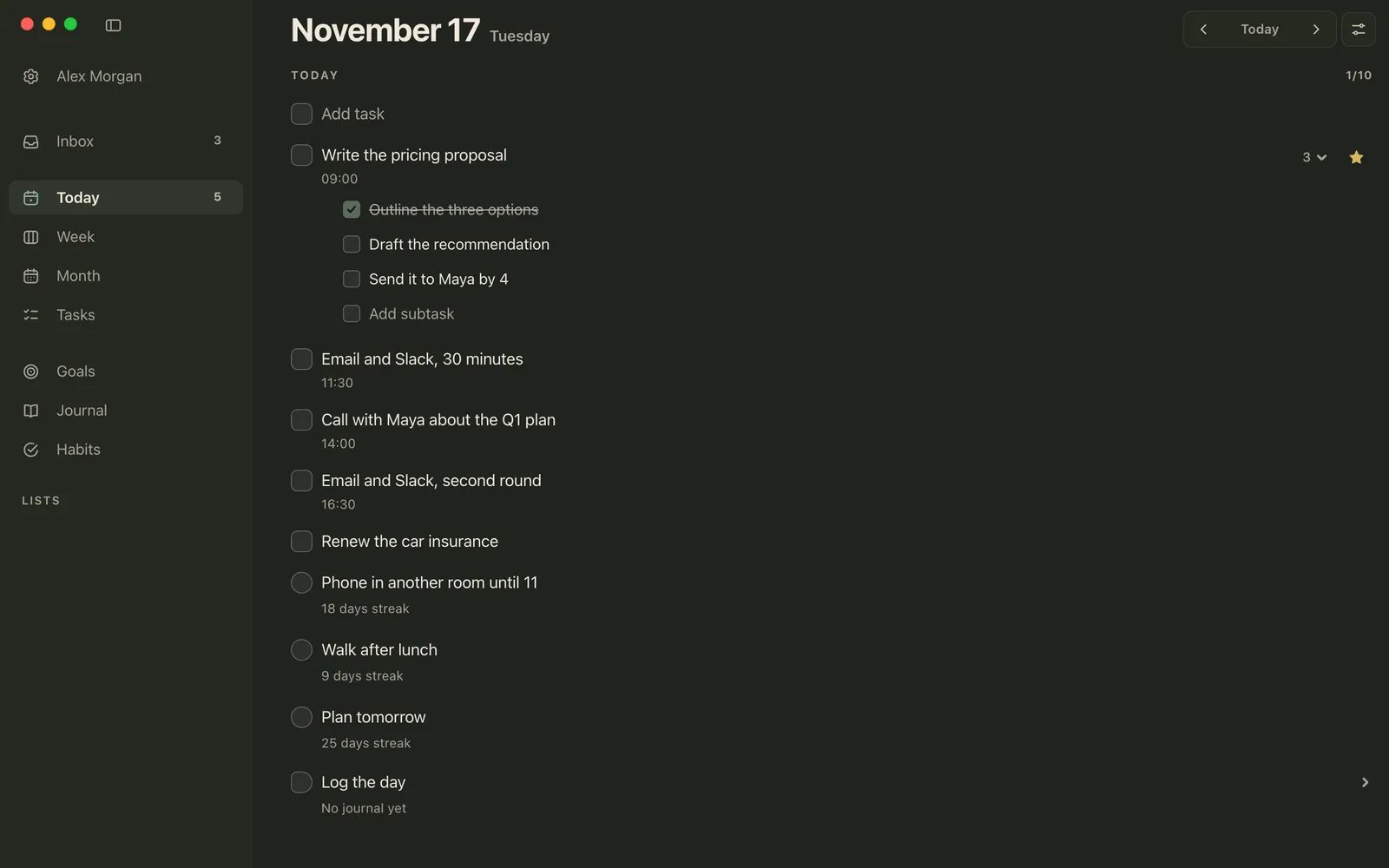
Here’s the day from our screenshots, Tuesday, November 17, planned the evening before in about ten minutes.
- The one thing: the pricing proposal, due to Maya at 4. It gets 9:00 and a star, and its first steps go underneath: outline the three options, draft the recommendation, send it.
- What’s fixed: a call with Maya at 14:00.
- Email and Slack: two rounds, at 11:30 and 16:30, half an hour each.
- The small stuff: renew the car insurance, whenever there’s a gap.
- The habits that hold the day together: the phone stays in another room until 11, a walk after lunch, and before closing the laptop, tomorrow’s first task.
The morning goes to the proposal, with a short break in the middle. Whatever lands in between waits for 11:30. At the end of the day there’s one line about how it went, and the first task for Wednesday: prepare the client workshop, 9:00.
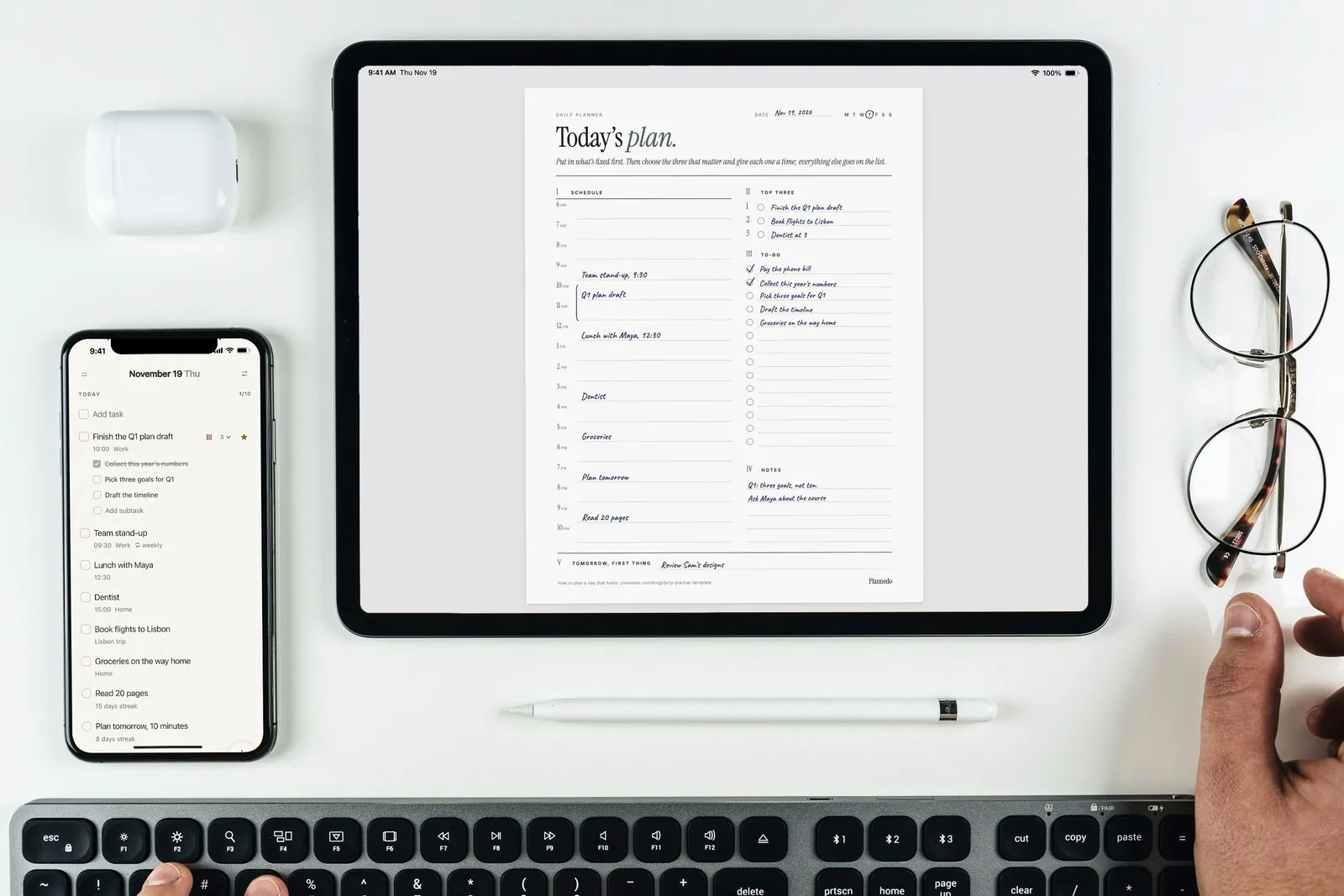
If you’d rather plan on paper, our daily planner template has the same structure on one page, and time blocking takes it further, with a block for every hour.
How to plan a productive week
A week plan is the same idea, zoomed out. On Sunday evening or Monday morning, give each weekday one main task, first thing, and put in what’s fixed: calls, appointments, deadlines. Leave the afternoons mostly empty. They’re for the overruns and for whatever comes up, and the week survives contact with reality because of that slack.
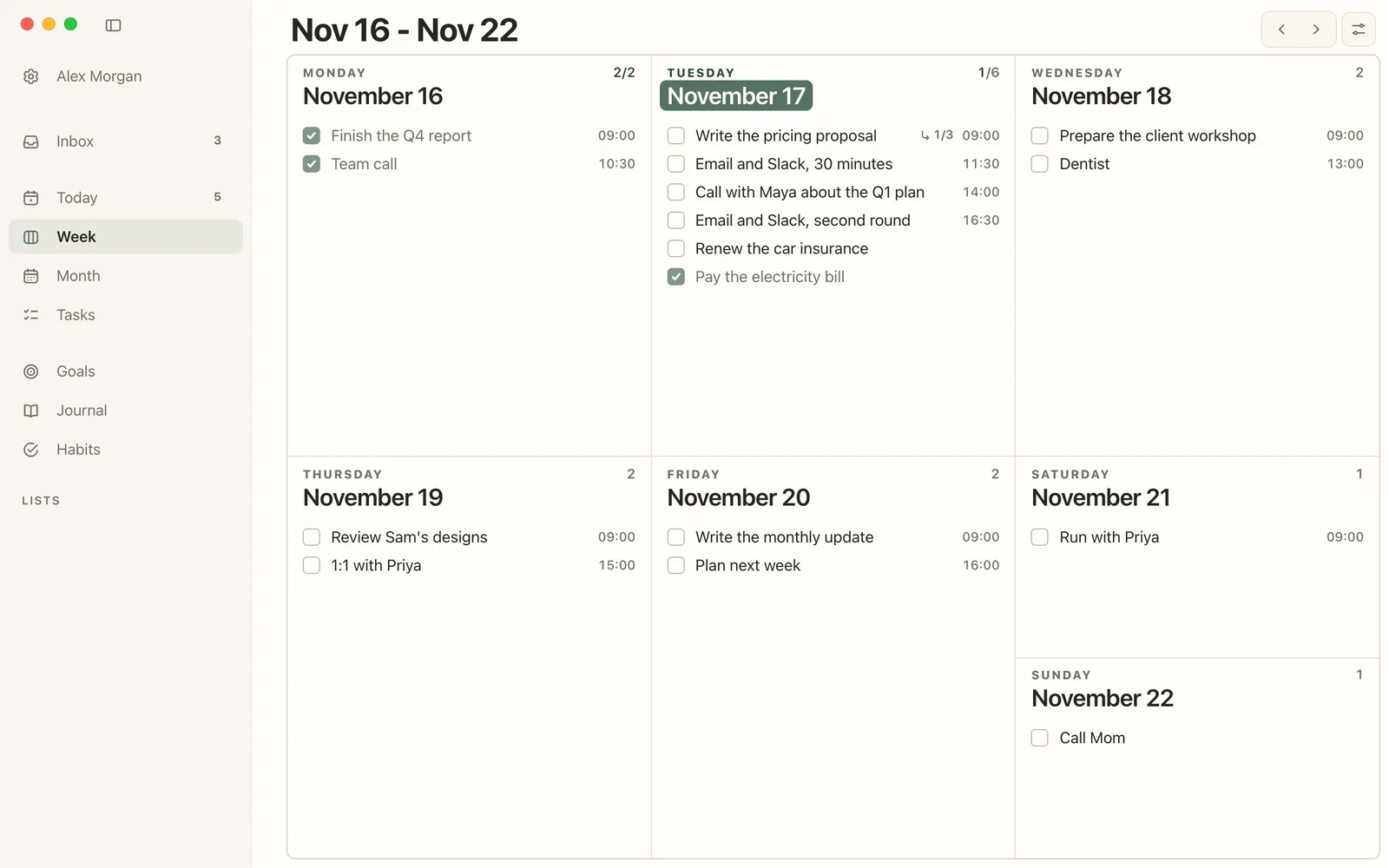
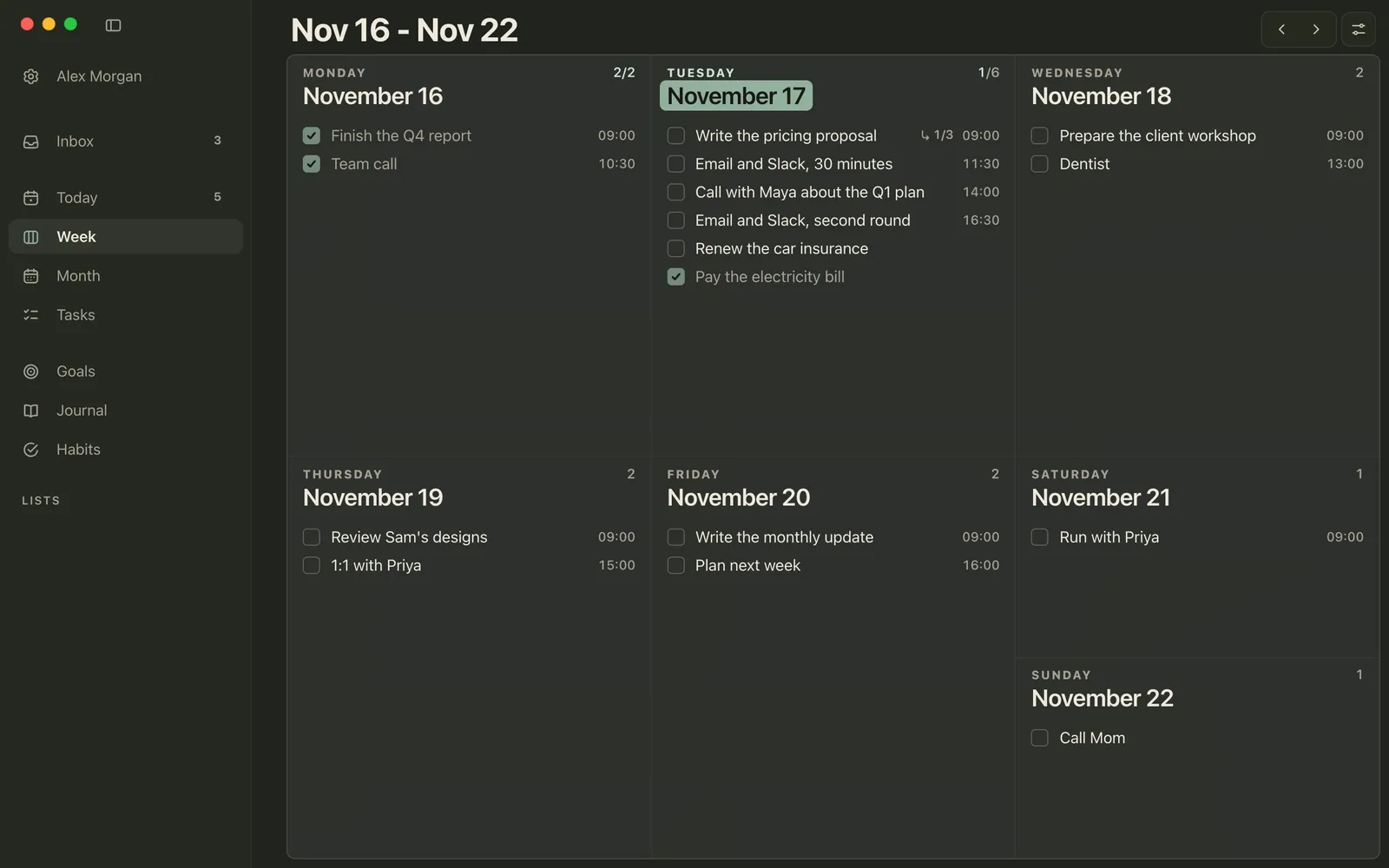
The whole method, with a weekly review on Friday, is in how to plan your week.
How many hours a day can you actually be productive?
Busy for eight hours, yes. Focused for eight, rarely, and nobody has a precise number. The best long-run data is Pencavel’s (habit 11): output kept pace with hours up to about 49 a week, and after that extra hours bought less and less. Add the sleep research and the cost of switching, and the honest answer is “fewer hours than you schedule”.
We plan on about three to four hours of focused work on a good day. That’s a rule of thumb, not a finding. Put those hours where your day is quietest, protect them, and let the rest of the day be meetings, email and small tasks.
How to be productive when you don’t feel like it
Some days nothing starts. Lower the bar until starting is easy: one first step, five minutes, with permission to stop after them. Most of the time you won’t.
Procrastination isn’t only about willpower; the task matters too. In Piers Steel’s meta-analysis of 691 correlations, people delayed most when a task was unpleasant, its reward was far off and they doubted they could do it well. So make the task smaller, nearer and clearer: “open the file and write the first heading” instead of “write the report”.
And forgive yourself for yesterday. In a study of 119 first-year students by Michael Wohl, Timothy Pychyl and Shannon Bennett, those who forgave themselves for procrastinating before one exam procrastinated less before the next. If it’s every day and comes with low mood or exhaustion, talk to a doctor; that isn’t a productivity problem. When the trouble is starting at all, our guide to ADHD paralysis goes through it step by step.
A productive day in Plannedo
We built Plannedo around exactly this kind of day, so each habit above has a place in it:
- Catch loose thoughts in the Inbox as they come up, and sort them later, so they don’t break the morning.
- On Week, give each morning its main task, and drag things between days when the week changes.
- On Today, give the important task a time and a star. Starred tasks come first in their day, and the first steps sit under the task as subtasks.
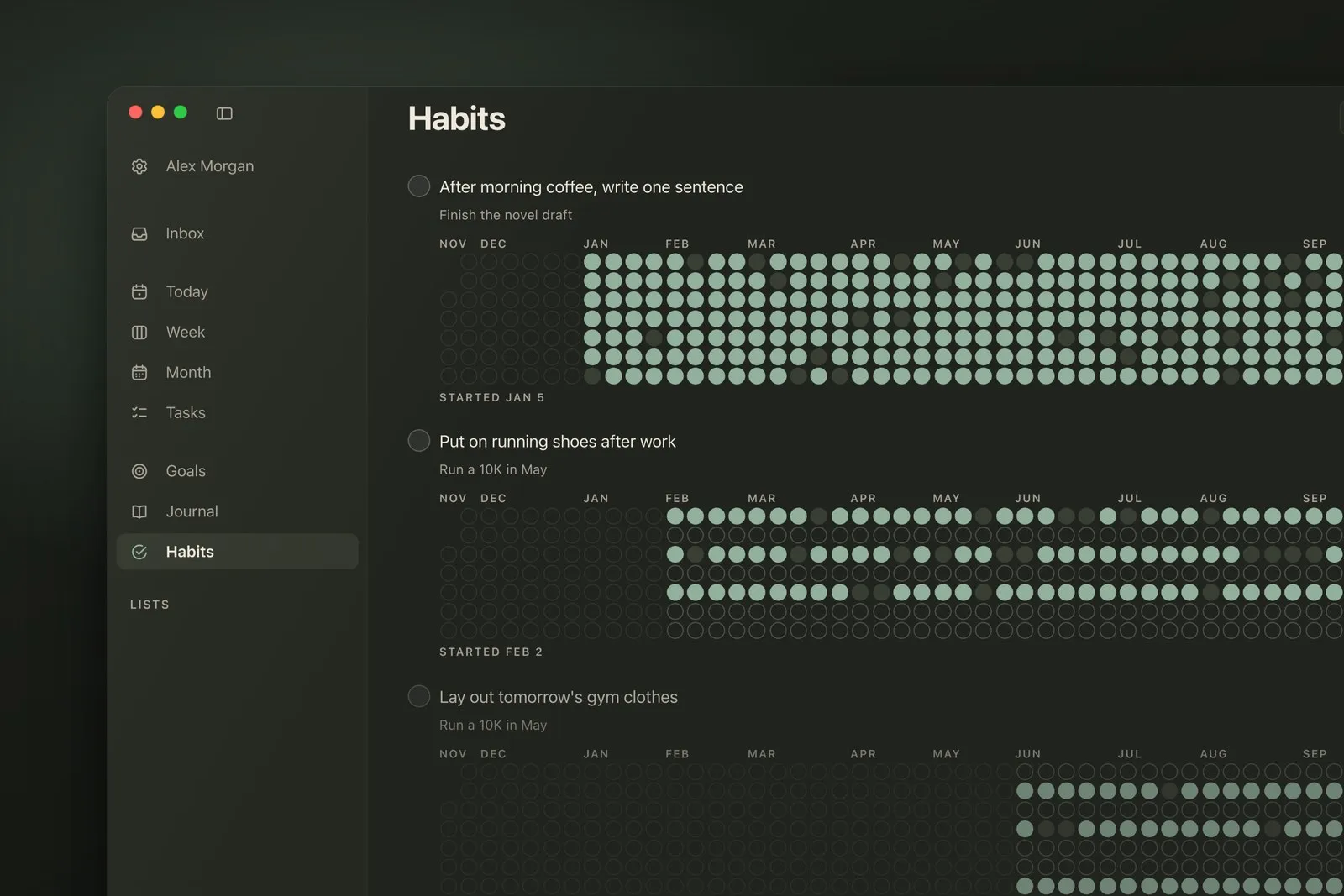
- Keep the habits that protect the day on the same sheet, with their streaks: Plan tomorrow, Walk after lunch, or whatever yours are.
- In the evening, Log the day: a line about how it went, and for each goal, whether today moved it.
It runs on iPhone, Mac and the web, and everything stays in sync.
FAQ
How do I train myself to be more productive?
Start with one habit, not twelve. The best first one is planning tomorrow’s first task, with a time, before you stop work. When it’s automatic, add the next: email in rounds, then breaks. Expect a new habit to take weeks or months to settle, not days; we looked at the research in how long it takes to form a habit.
Why am I not productive anymore?
Usually it’s one of four things: too little sleep, too many open commitments, a day run by interruptions, or a task you’re avoiding because its next step isn’t clear. Check sleep first, then whether you can name the next step of the work that matters. If it lasts for weeks and comes with low mood or exhaustion, talk to a doctor.
Is it possible to be productive for 8 hours a day?
You can be busy for eight hours, but few people manage eight hours of focused work, day after day. Plan on three to four focused hours on a good day, as a rule of thumb, and fill the rest with meetings, email and smaller tasks.
Does the Pomodoro Technique actually work?
There’s very little direct research. The one study we know of, with 87 students over a single day, found fixed breaks left people less tired and more focused than breaks they chose themselves, with the same amount done. Short breaks in general do help people feel more energetic. Use Pomodoro if the timer helps you start; it isn’t magic.
Is multitasking bad for productivity?
For tasks that need thinking, yes. Doing two of them “at once” really means switching between them, and every switch costs some time and attention. Group similar small tasks together, and give the important one an uninterrupted block.
How often should you take breaks?
No study has found the perfect rhythm. Short breaks of a few minutes leave people less tired, and longer ones did more for performance. A short break every hour or so, and a real lunch away from the screen, is a sensible place to start.
What is a productivity hack?
A shortcut that promises more done for less effort, like a timer method, a rule for email or a trick for starting. The ones that hold up in research are mostly plain habits: deciding when and where you’ll do something, doing the important task first, batching interruptions, resting and keeping track of progress.
What makes a day productive?
Progress on something that matters to you, even a small step. A day can be packed and still unproductive, and a day with one finished piece of real work and an early night can be a very good one.
Studies and sources
- Aeon, B., Faber, A., & Panaccio, A. (2021). Does time management work? A meta-analysis. PLOS ONE, 16(1), e0245066.
- Locke, E. A., & Latham, G. P. (2002). Building a practically useful theory of goal setting and task motivation: A 35-year odyssey. American Psychologist, 57(9), 705-717.
- Dalton, A. N., & Spiller, S. A. (2012). Too much of a good thing: The benefits of implementation intentions depend on the number of goals. Journal of Consumer Research, 39(3), 600-614.
- Sheeran, P., Listrom, O., & Gollwitzer, P. M. (2025). The when and how of planning: Meta-analysis of the scope and components of implementation intentions in 642 tests. European Review of Social Psychology, 36(1), 162-194.
- Gollwitzer, P. M., & Sheeran, P. (2006). Implementation intentions and goal achievement: A meta-analysis of effects and processes. Advances in Experimental Social Psychology, 38, 69-119.
- Masicampo, E. J., & Baumeister, R. F. (2011). Consider it done! Plan making can eliminate the cognitive effects of unfulfilled goals. Journal of Personality and Social Psychology, 101(4), 667-683.
- Smit, B. W. (2016). Successfully leaving work at work: The self-regulatory underpinnings of psychological detachment. Journal of Occupational and Organizational Psychology, 89(3), 493-514.
- Scullin, M. K., Krueger, M. L., Ballard, H. K., Pruett, N., & Bliwise, D. L. (2018). The effects of bedtime writing on difficulty falling asleep: A polysomnographic study comparing to-do lists and completed activity lists. Journal of Experimental Psychology: General, 147(1), 139-146.
- Buehler, R., Griffin, D., & Ross, M. (1994). Exploring the “planning fallacy”: Why people underestimate their task completion times. Journal of Personality and Social Psychology, 67(3), 366-381.
- Kruger, J., & Evans, M. (2004). If you don’t want to be late, enumerate: Unpacking reduces the planning fallacy. Journal of Experimental Social Psychology, 40(5), 586-598.
- Roy, M. M., Christenfeld, N. J. S., & McKenzie, C. R. M. (2005). Underestimating the duration of future events: Memory incorrectly used or memory bias? Psychological Bulletin, 131(5), 738-756.
- Ibanez, M. R., Clark, J. R., Huckman, R. S., & Staats, B. R. (2018). Discretionary task ordering: Queue management in radiological services. Management Science, 64(9), 4389-4407.
- Rubinstein, J. S., Meyer, D. E., & Evans, J. E. (2001). Executive control of cognitive processes in task switching. Journal of Experimental Psychology: Human Perception and Performance, 27(4), 763-797.
- Leroy, S. (2009). Why is it so hard to do my work? The challenge of attention residue when switching between work tasks. Organizational Behavior and Human Decision Processes, 109(2), 168-181.
- Leroy, S., & Glomb, T. M. (2018). Tasks interrupted: How anticipating time pressure on resumption of an interrupted task causes attention residue and low performance on interrupting tasks and how a “ready-to-resume” plan mitigates the effects. Organization Science, 29(3), 380-397.
- Kushlev, K., & Dunn, E. W. (2015). Checking email less frequently reduces stress. Computers in Human Behavior, 43, 220-228.
- Kushlev, K., Proulx, J., & Dunn, E. W. (2016). “Silence your phones”: Smartphone notifications increase inattention and hyperactivity symptoms. Proceedings of CHI 2016, 1011-1020.
- Parke, M. R., Weinhardt, J. M., Brodsky, A., Tangirala, S., & DeVoe, S. E. (2018). When daily planning improves employee performance: The importance of planning type, engagement, and interruptions. Journal of Applied Psychology, 103(3), 300-312.
- Mark, G., Gudith, D., & Klocke, U. (2008). The cost of interrupted work: More speed and stress. Proceedings of CHI 2008, 107-110.
- Albulescu, P., Macsinga, I., Rusu, A., Sulea, C., Bodnaru, A., & Tulbure, B. T. (2022). “Give me a break!” A systematic review and meta-analysis on the efficacy of micro-breaks for increasing well-being and performance. PLOS ONE, 17(8), e0272460.
- Oppezzo, M., & Schwartz, D. L. (2014). Give your ideas some legs: The positive effect of walking on creative thinking. Journal of Experimental Psychology: Learning, Memory, and Cognition, 40(4), 1142-1152.
- Van Dongen, H. P. A., Maislin, G., Mullington, J. M., & Dinges, D. F. (2003). The cumulative cost of additional wakefulness: Dose-response effects on neurobehavioral functions and sleep physiology from chronic sleep restriction and total sleep deprivation. Sleep, 26(2), 117-126.
- Lim, J., & Dinges, D. F. (2010). A meta-analysis of the impact of short-term sleep deprivation on cognitive variables. Psychological Bulletin, 136(3), 375-389.
- Pencavel, J. (2015). The productivity of working hours. The Economic Journal, 125(589), 2052-2076.
- Fan, W., Schor, J. B., Kelly, O., & Gu, G. (2025). Work time reduction via a 4-day workweek finds improvements in workers’ well-being. Nature Human Behaviour, 9(10), 2153-2168.
- Harkin, B., Webb, T. L., Chang, B. P. I., Prestwich, A., Conner, M., Kellar, I., Benn, Y., & Sheeran, P. (2016). Does monitoring goal progress promote goal attainment? A meta-analysis of the experimental evidence. Psychological Bulletin, 142(2), 198-229.
- Amabile, T. M., & Kramer, S. J. (2011). The power of small wins. Harvard Business Review, 89(5).
- Steel, P. (2007). The nature of procrastination: A meta-analytic and theoretical review of quintessential self-regulatory failure. Psychological Bulletin, 133(1), 65-94.
- Wohl, M. J. A., Pychyl, T. A., & Bennett, S. H. (2010). I forgive myself, now I can study: How self-forgiveness for procrastinating can reduce future procrastination. Personality and Individual Differences, 48(7), 803-808.
- Hagger, M. S., Chatzisarantis, N. L. D., Alberts, H., et al. (2016). A multilab preregistered replication of the ego-depletion effect. Perspectives on Psychological Science, 11(4), 546-573.
- Vohs, K. D., Schmeichel, B. J., Lohmann, S., et al. (2021). A multisite preregistered paradigmatic test of the ego-depletion effect. Psychological Science, 32(10), 1566-1581.
- Gallup Business Journal (2006). Too many interruptions at work? Interview with Gloria Mark, June 8, 2006.
- American Psychological Association (2006). Multitasking: Switching costs.
- DeskTime. Does the 52-17 rule really hold up? DeskTime blog.
- Biwer, F., Wiradhany, W., oude Egbrink, M. G. A., & de Bruin, A. B. H. (2023). Understanding effort regulation: Comparing ‘Pomodoro’ breaks and self-regulated breaks. British Journal of Educational Psychology, 93(S2), 353-367.
- Rey-Mermet, A., & Rothen, N. (2023). The interplay of time-of-day and chronotype results in no general and robust cognitive boost. Collabra: Psychology, 9(1), 88337.
- Ward, A. F., Duke, K., Gneezy, A., & Bos, M. W. (2017). Brain drain: The mere presence of one’s own smartphone reduces available cognitive capacity. Journal of the Association for Consumer Research, 2(2), 140-154.
- Ruiz Pardo, A. C., & Minda, J. P. (2022). Reexamining the “brain drain” effect: A replication of Ward et al. (2017). Acta Psychologica, 230, 103717.
- Böttger, T., Poschik, M., & Zierer, K. (2023). Does the brain drain effect really exist? A meta-analysis. Behavioral Sciences, 13(9), 751.
- Parry, D. A. (2024). Does the mere presence of a smartphone impact cognitive performance? A meta-analysis of the “brain drain effect”. Media Psychology, 27(5), 737-762.
- Harvard Library. I heard about a Harvard study saying that “people who write down their projects and dreams” easily achieve success in the future. Do you have any research showing something like that? Ask a Librarian.
- Quote Investigator (2013). Eat a live frog every morning, and nothing worse will happen to you the rest of the day.
Photo credits
The cover photo is by Jakub Żerdzicki on Unsplash.