Wheel of Life: The 8 Areas, How to Use It, and What to Do Next
What the wheel of life is, the 8 areas and what to ask for each, how to score and read it, three example wheels, what research says, and how to turn the lowest area into a goal. With a free online wheel and a printable template.
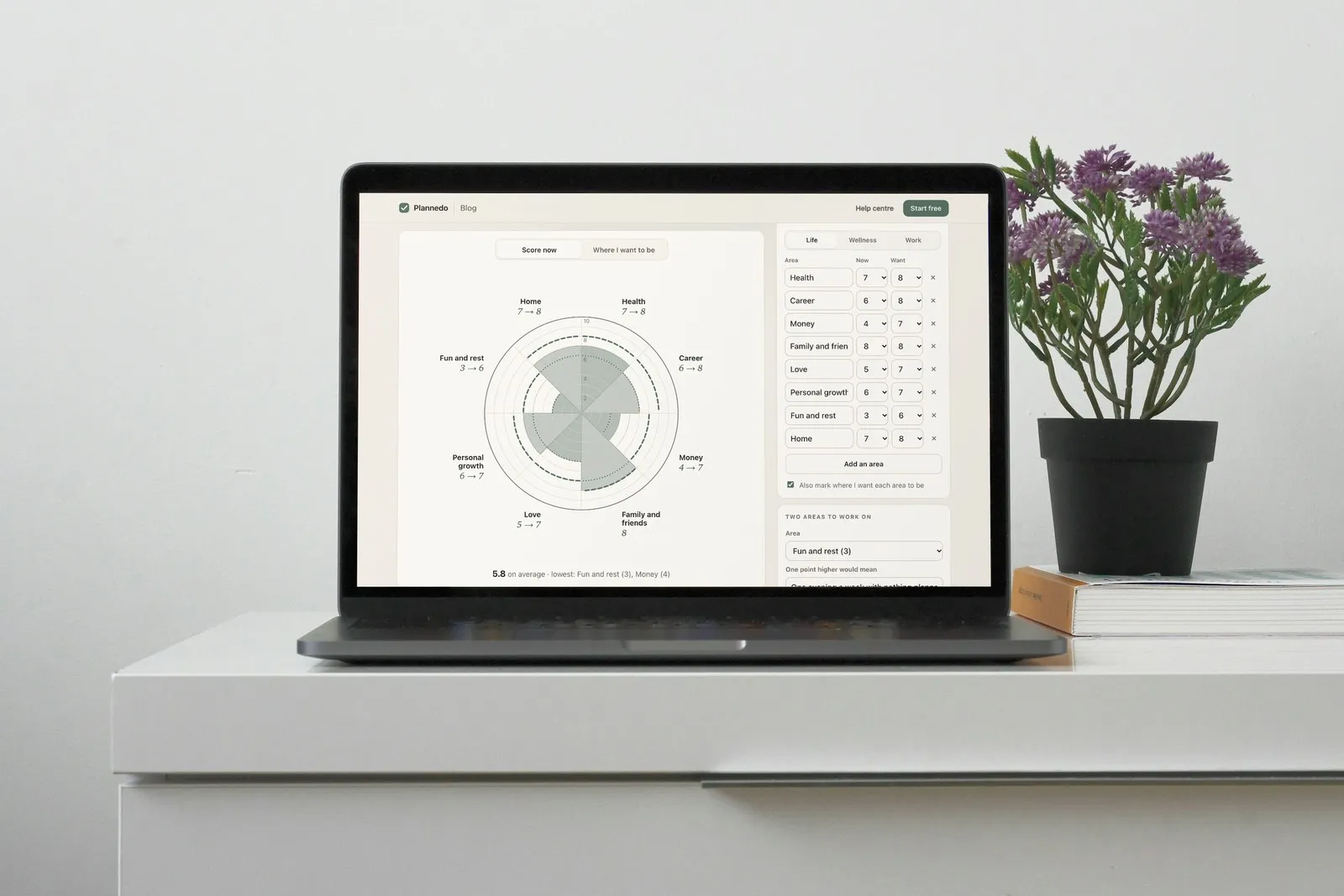
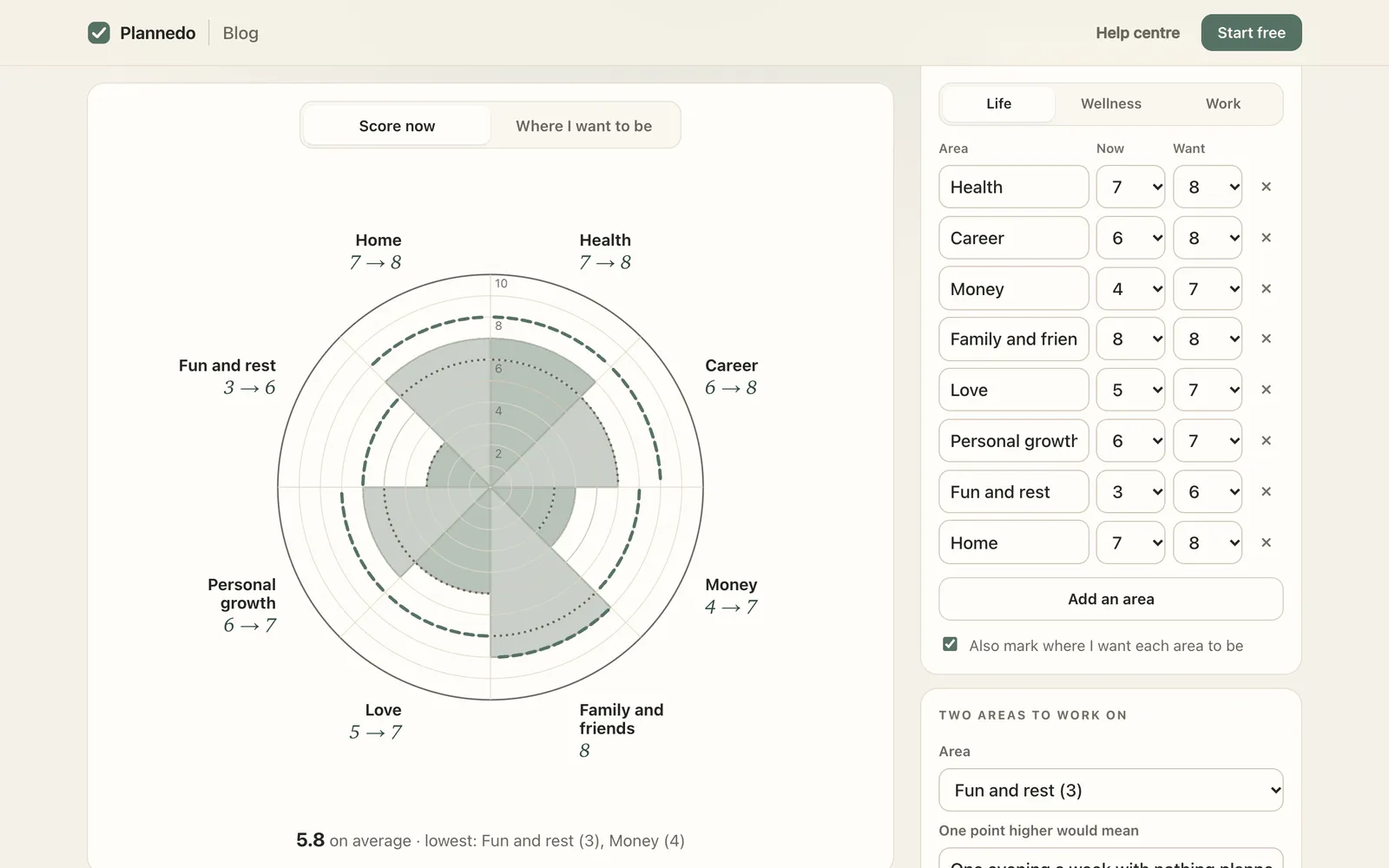
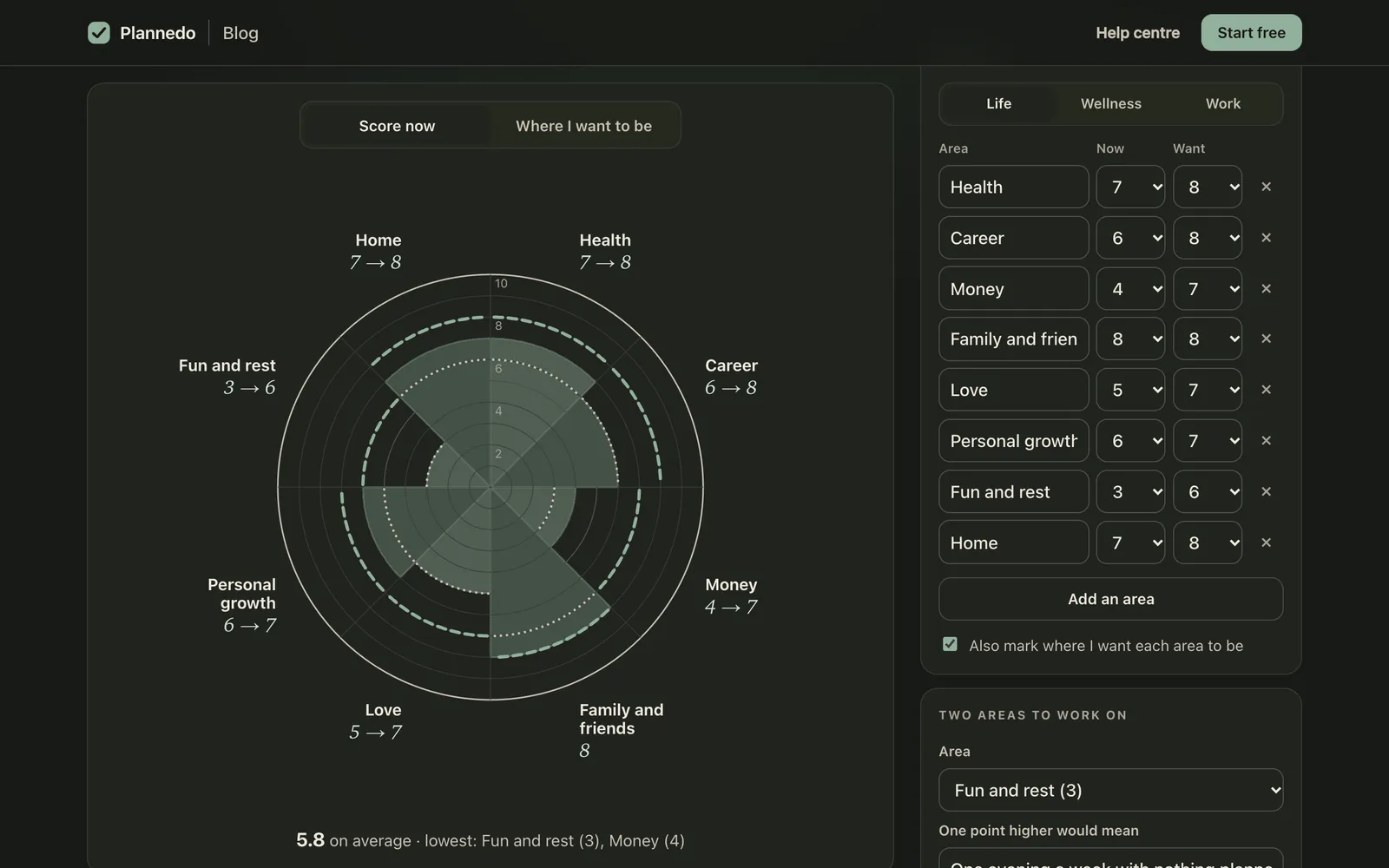
The wheel of life is a circle cut into eight slices, one for each area of your life: health, career, money, family and friends, love, personal growth, fun and rest, and home. You score each one from 1 to 10 for how satisfied you are with it right now, shade the slices, and look at the shape you get. It takes ten minutes, and it’s good at one thing: showing you which part of your life you’ve stopped looking at.
You can do it on paper or with our free wheel of life: tap each slice to score it, mark where you want each area to be, and print the page or download it as a fillable PDF. Below: what each area covers, how to score honestly, how to read the shape, three example wheels, what the research says, and the step most people skip, turning the lowest slice into something you’ll do this week.
What is the wheel of life?
It’s a self-assessment coaches use at the start of working with someone, and a lot of people do it on their own once or twice a year. The idea is simple: life satisfaction isn’t one number. You can love your job and be lonely, or have money and no time. Scoring each area separately makes the uneven parts visible, and the circle makes them visible at a glance.
Its history is murky. The wheel is usually credited to Paul J. Meyer, the founder of the Success Motivation Institute, and a six-area “Total Person” wheel of life appears in sales-training books from the late 1980s that cite his company’s programs. The eight-area version most people use today spread through coaching: the Coaches Training Institute’s Co-Active Coaching put a wheel of life in its first edition in 1998. The date you’ll often read, the 1960s, has no source we could find. In the US, “Wheel of Life” is also a registered trademark for books and manuals.
One more thing to know up front: it’s an exercise, not a test. Nobody has validated it the way a psychological questionnaire is validated, and the scores mean what they mean to you.
The 8 areas of the wheel of life
There’s no official list. These eight are the most common, and the questions are what to think about while you score.
| Area | What to ask yourself |
|---|---|
| Health | Do I sleep, eat and move in a way I’m happy with? How’s my energy? |
| Career | Is my work using what I’m good at? Is it taking me somewhere? |
| Money | Do I know where it goes? Is there something left over? |
| Family and friends | Do I see the people who matter as often as I’d like? |
| Love | Am I happy with my relationship, or with being single? |
| Personal growth | Am I learning something, or getting better at something? |
| Fun and rest | When did I last do something just because I enjoy it? |
| Home | Do I like coming back to where I live? |
Change the list to fit your life. Some people split family and friends, add spirituality or contribution, or drop love when they’re not looking for it. Two other common sets:
- The wellness wheel: the eight dimensions of wellness, physical, emotional, social, intellectual, spiritual, occupational, financial and environmental.
- A work wheel: the work itself, skills, team, manager, pay, workload, growth and meaning. It’s a good way to see what exactly is wrong with a job before you decide to leave it.
Both sets are built into the free tool, and you can rename any area or have from 3 to 12.
How to use the wheel of life
- Pick your areas. Eight is a good number: enough to cover a life, few enough to score in a few minutes.
- Score each area from 1 to 10 for satisfaction, not importance. “How satisfied am I with my health right now?”, not “How important is health?” or “How healthy should I be?” Go with your first answer.
- Mark where you want each area to be. Not everything needs a 10. If money is a 6 and a 7 would do, the gap is one point, not four.
- Look at the shape before the numbers. Which slices are lowest? Where are the widest gaps?
- Choose one or two areas, not all of the low ones. For each, ask what one point higher would look like: if fun is a 2, what would a 3 be?
- Write a first step for this week, with a day. Then put a date in your calendar to score the wheel again.
On scoring honestly: you may have read that a sunny day or finding a coin can change how people rate their lives. Those famous findings mostly didn’t hold up. In data from more than a million Americans, Richard Lucas and Nicole Lawless found that the weather doesn’t reliably affect life satisfaction judgments, and a 2017 set of replications by Stephanie Yap and colleagues found mood effects less than a tenth the size of the originals. Ratings of your own life are steadier than that. Still, score on an ordinary day, not the evening after a fight.
How to read your wheel: three examples
The average tells you little. Two wheels can both average 5.6 and mean completely different things.
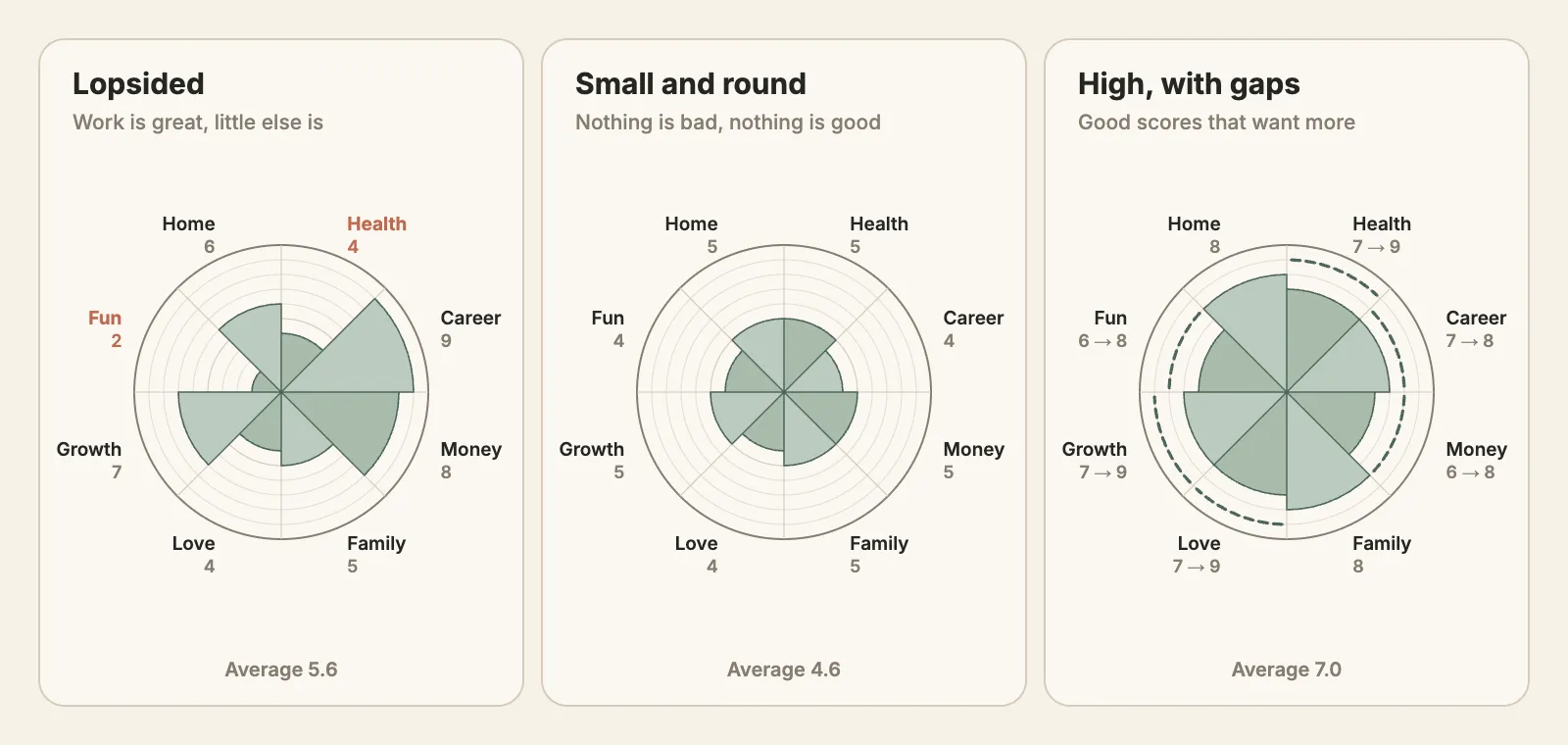
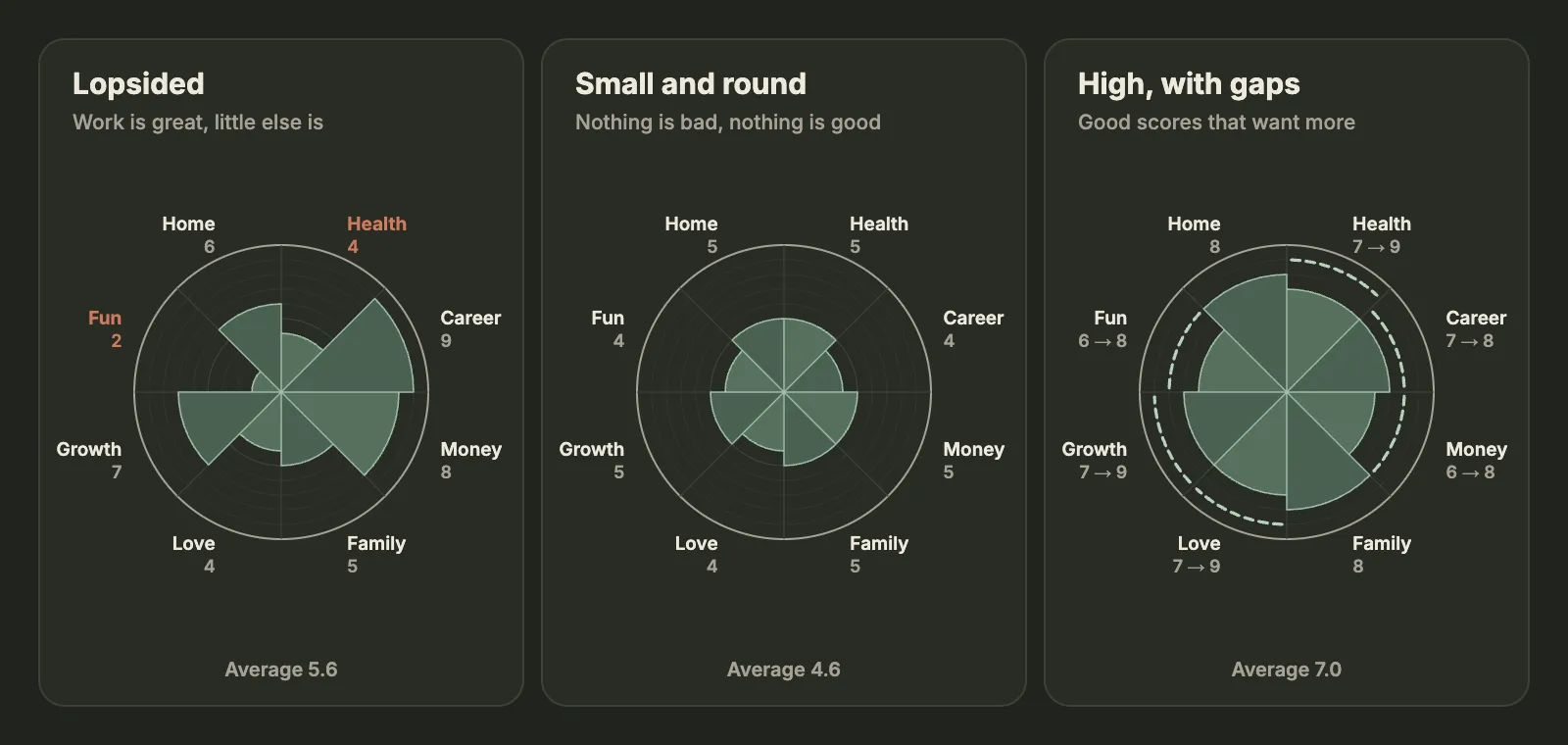
Lopsided. Career 9, money 8, fun 2, health 4. This is the classic busy-professional wheel: one part of life is eating the others. The lowest slice is fun, but the one to start with may be health: sleep and energy lift almost every other area, including the evenings you’d spend on fun. Pick one of the two, not both.
Small and round. Everything a 4 or 5. Nothing is on fire, so nothing gets attention. Here the lowest slice doesn’t matter much; pick the area where one small change would feel best this month, and expect the others to move a little with it. If a wheel like this comes with feeling flat most days for weeks, that’s worth talking to a doctor or a therapist about; the wheel isn’t built to tell the difference.
High, with gaps. Mostly 7s and 8s, and wanting 9s. A good life with an itch. The want scores matter more here than the low ones: the gaps of two points (health, love, growth) are where the energy is. A 6 in money that you’d be happy to make a 7 is a smaller job than it looks.
What research suggests is worth taking from all three: the gap between how things are and how you want them matters more than a perfectly round wheel. In a study of how people spend their time, Kathleen Matuska found that a match between the time people wanted to spend on their activities and the time they actually spent went with lower stress and higher well-being; spreading time evenly across activities, on its own, didn’t.
What the research says
There’s no research on the wheel of life as a tool, but there’s a fair amount on the ideas behind it.
- Areas add up to a life. A meta-analysis by Daniel Heller, David Watson and Remus Ilies found that satisfaction with specific areas of life is strongly linked to overall life satisfaction, but only weakly linked from one area to the next. That’s the whole case for scoring areas separately: how satisfied someone is with one area tells you surprisingly little about the next.
- Balance matters, a little. Kennon Sheldon, Robert Cummins and Shanmukh Kamble measured balance as how evenly people spread their time across life areas, and how close their actual time was to their ideal time. Both went with higher well-being, in American and Indian samples, and people who met a month-long goal to improve their balance gained well-being. In an earlier set of studies, Sheldon and Christopher Niemiec found that at the same total, evenly met psychological needs went with higher well-being than lopsided ones.
- Which areas weigh most differs. In a study of 530 workers in Chile, satisfaction with finances and family predicted overall life satisfaction more than satisfaction with work or health did. Other groups weigh things differently, which is a good reason to set your own want scores instead of aiming for 10s.
- One goal beats six. Amy Dalton and Stephen Spiller found that making a specific plan helped people follow through on one goal, but usually not when they planned for several at once: planning made it obvious how hard the whole list was. That’s why the wheel should end in one or two areas, not eight.
- The slice you stare at looks bigger. David Schkade and Daniel Kahneman found that students in the Midwest and in Southern California were equally satisfied with their lives, though both groups expected Californians to be happier, because they focused on the weather. Whatever you’re thinking about feels more important than it is; a lowest slice can feel like your whole life while you’re looking at it.
What to do after the wheel of life
The wheel is the diagnosis; it doesn’t change anything by itself. Most people score it, nod at the shape, and put it in a drawer. What moves a slice is turning it into something with a day attached.
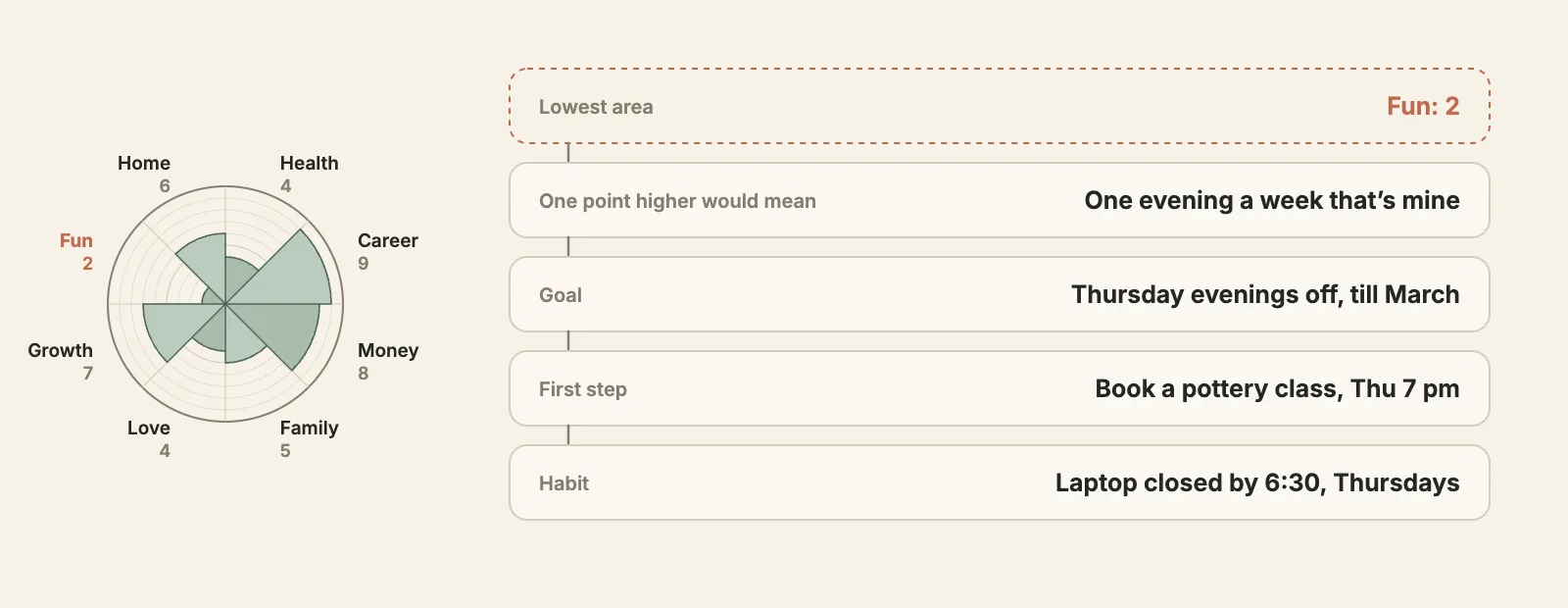
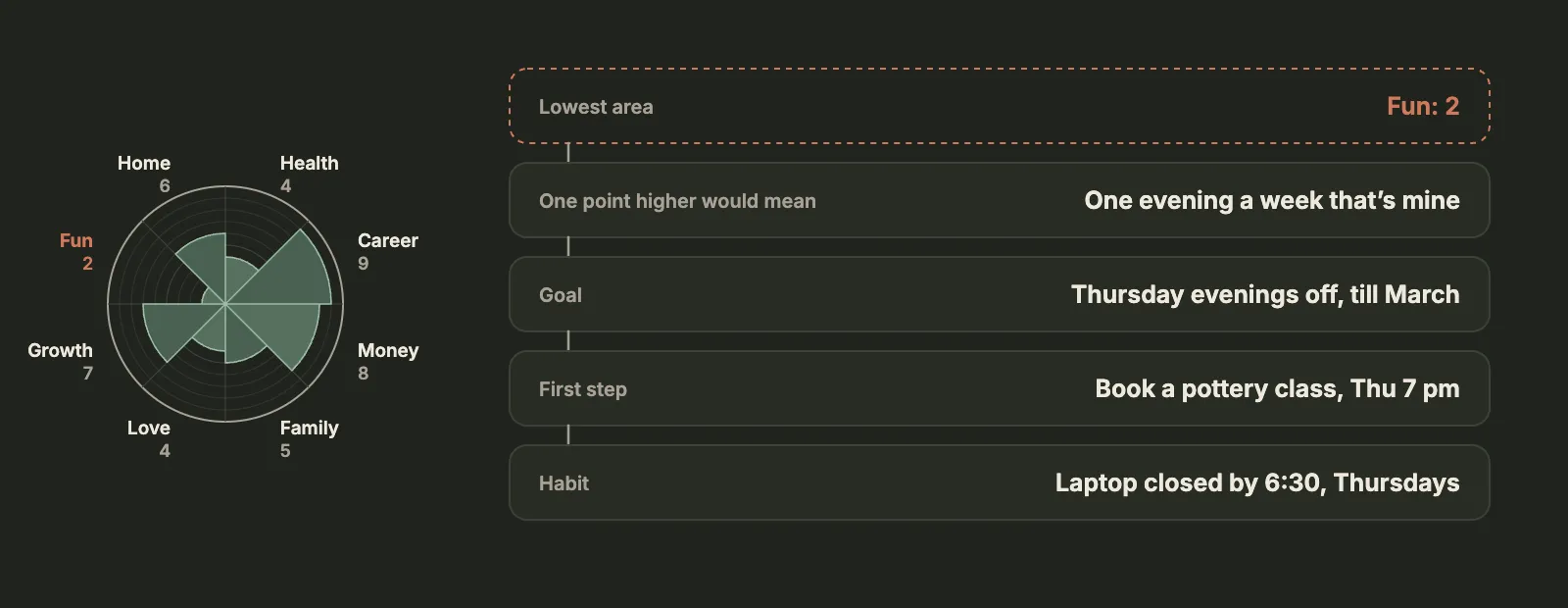
- Name one point higher. Not “fix my health” but “a 5 would mean sleeping seven hours on weeknights”. One point is small enough to believe in.
- Turn it into a goal with a time frame. “Thursday evenings off, till March.” Three months is long enough to notice and short enough to stick to. Our guide on how to set goals covers the wording.
- Give it a first step this week, with a day and a time. “Book a pottery class, Thursday at 7.” A step without a day is a wish.
- Add one habit if the change is a repeat. “Laptop closed by 6:30 on Thursdays.” One, not five.
- Score the wheel again in a month or a quarter, with the same areas and the same scale, and compare. The free tool saves each wheel in your browser and draws the last one as a dotted line on the new one.
If you’d like more ideas for each area, our lists of life goals examples and personal goals examples are sorted by the same kinds of areas, and a vision board is a good way to keep a goal in front of you once you’ve picked it.
From the wheel to a goal in Plannedo
Plannedo is where the two areas can go next. Each goal is a board you fill with your own pictures and words, with a line about why it matters, a time frame, and the habits and tasks that move it. When you tick off something linked to a goal, the goal is marked as moved that day, and in the evening Log the day asks about the rest: Moved, Thought or Not today.
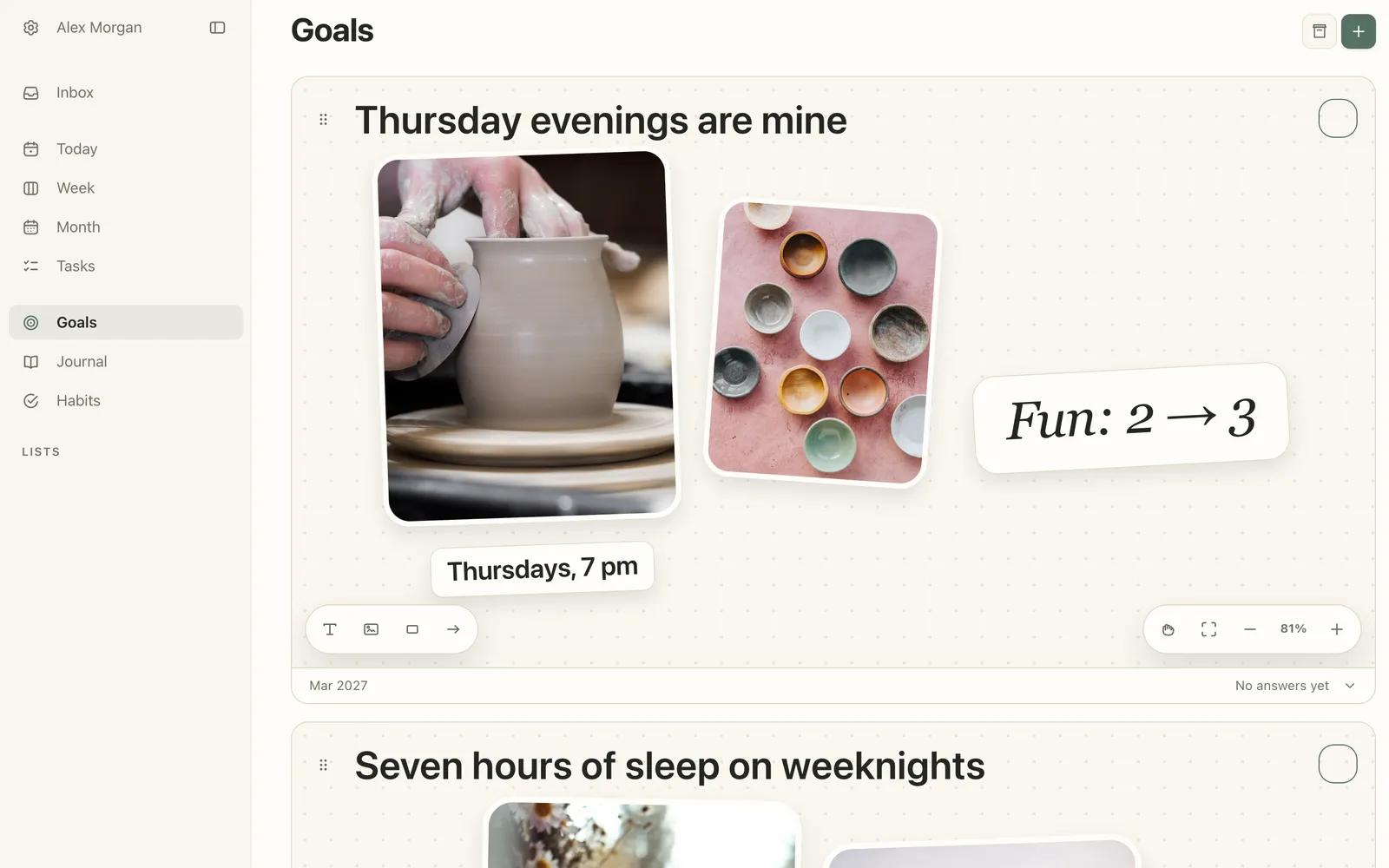
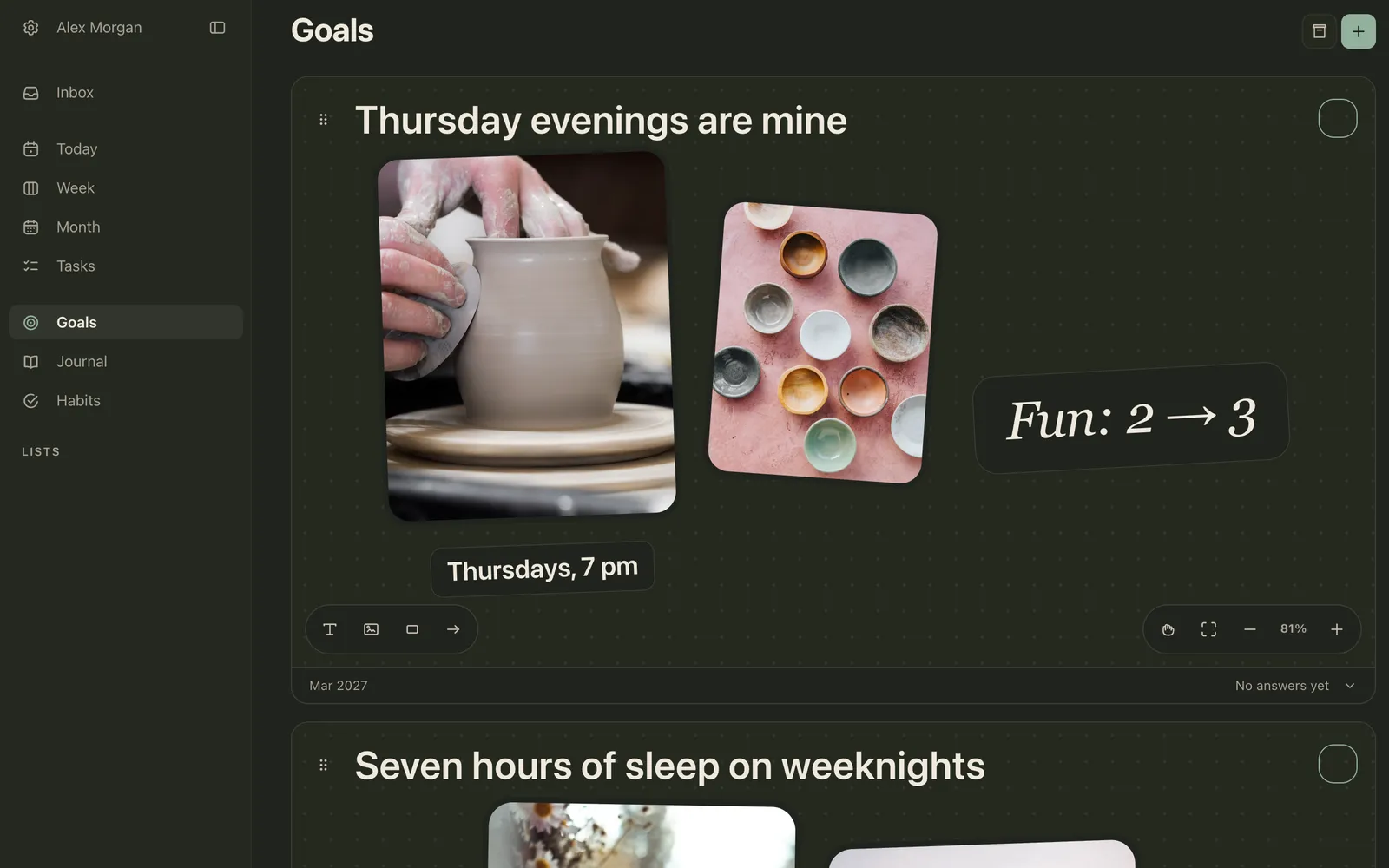
The board also shows up small on Today, every day, so the slice you chose doesn’t disappear again until the next time you score the wheel. The Free plan includes one goal with a full board and up to three habits, which is exactly enough for the area you’d pick first. More in the help centre: goal boards, connecting tasks and habits to a goal and the evening check-in.
FAQ
What is the wheel of life?
A self-assessment that splits life into areas, usually eight, such as health, career, money, family and friends, love, personal growth, fun and rest, and home. You score each from 1 to 10 for how satisfied you are and shade a circle to match, so the uneven parts of your life show at a glance.
Who created the wheel of life?
It’s usually credited to Paul J. Meyer, the founder of the Success Motivation Institute. A six-area “Total Person” version appears in sales-training books from the late 1980s that cite his company’s programs, and the eight-area version spread through coaching after the Coaches Training Institute’s Co-Active Coaching (1998). The often-quoted 1960s origin has no source we could find.
What are the 8 areas of the wheel of life?
There’s no fixed list. The most common eight are health, career, money, family and friends, love (or romance), personal growth, fun and recreation, and home (or physical environment). Coaches often swap in spirituality, contribution or community. Use the areas that describe your life.
How do you use the wheel of life?
Score each area from 1 to 10 for how satisfied you are now, then mark where you’d like it to be. Look at the lowest slices and the widest gaps, pick one or two areas, write what one point higher would mean, and give each a first step this week. Score it again in a month or a quarter.
What should I do if all my scores are the same?
A wheel where everything is a 4 or 5 usually means nothing is urgent enough to get attention. Pick the area where a small change would feel best this month rather than the lowest number. If the flat scores come with feeling low most days for weeks, talk to a doctor or a therapist; the wheel isn’t designed to spot that.
How often should you do the wheel of life?
Every three months is a good rhythm, and once a year at the least, for example at the start of January. Monthly works if you’re actively changing something. Keep the same areas and scale each time, so the wheels can be compared.
Is the wheel of life scientifically validated?
No. It’s a coaching exercise, not a validated test, and it can’t diagnose anything. Research does support its building blocks: satisfaction with life areas adds up to overall life satisfaction, and a small gap between how you spend your time and how you’d like to goes with lower stress.
What’s the difference between a wheel of life and a vision board?
The wheel shows where you are in each area; a vision board shows where you want one area to go. They work well in that order: score the wheel, pick the area to work on, then make a board for that one goal.
Studies and sources
- Heller, D., Watson, D., & Ilies, R. (2004). The role of person versus situation in life satisfaction: A critical examination. Psychological Bulletin, 130(4), 574-600.
- Sheldon, K. M., Cummins, R., & Kamble, S. (2010). Life balance and well-being: Testing a novel conceptual and measurement approach. Journal of Personality, 78(4), 1093-1134.
- Sheldon, K. M., & Niemiec, C. P. (2006). It’s not just the amount that counts: Balanced need satisfaction also affects well-being. Journal of Personality and Social Psychology, 91(2), 331-341.
- Matuska, K. (2012). Validity evidence of a model and measure of life balance. OTJR: Occupational Therapy Journal of Research, 32(1), 229-237.
- Loewe, N., Bagherzadeh, M., Araya-Castillo, L., Thieme, C., & Batista-Foguet, J. M. (2014). Life domain satisfactions as predictors of overall life satisfaction among workers: Evidence from Chile. Social Indicators Research, 118(1), 71-86.
- Dalton, A. N., & Spiller, S. A. (2012). Too much of a good thing: The benefits of implementation intentions depend on the number of goals. Journal of Consumer Research, 39(3), 600-614.
- Schkade, D. A., & Kahneman, D. (1998). Does living in California make people happy? A focusing illusion in judgments of life satisfaction. Psychological Science, 9(5), 340-346.
- Lucas, R. E., & Lawless, N. M. (2013). Does life seem better on a sunny day? Examining the association between daily weather conditions and life satisfaction judgments. Journal of Personality and Social Psychology, 104(5), 872-884.
- Yap, S. C. Y., Wortman, J., Anusic, I., Baker, S. G., Scherer, L. D., Donnellan, M. B., & Lucas, R. E. (2017). The effect of mood on judgments of subjective well-being: Nine tests of the judgment model. Journal of Personality and Social Psychology, 113(6), 939-961.
- Whitworth, L., Kimsey-House, H., & Sandahl, P. (1998). Co-Active Coaching: New Skills for Coaching People Toward Success in Work and Life. Davies-Black.
- US Patent and Trademark Office, registration 3918518, “WHEEL OF LIFE” (books and manuals), TSDR record.
Photo credits
The cover photo is by Rubén Menárguez on Unsplash. The pictures on the goal boards are from Unsplash, credited in our vision board pictures collection.